Cryptocurrency Fees: A Solution to Unreasonable State Growth

root7Z

July 9, 2021

This article is a continuation and summarization of “A Systematic Approach To Cryptocurrency Fees” (hereinafter referred to as the paper) by Alex (Kushti) Chepurnoy, Vasily Kharin and Dmitry Meshkov. In the paper, the authors address the problem of storage resources utilization. There is a concern that once an element of the state is created, it exists forever and inevitably balloons node disk space. This will lead to unreasonable state growth of the blockchain.

While cryptocurrencies address transaction fees as an atomic concept, the paper suggests that it is reasonable to take this into account on a 3-dimensional scale.
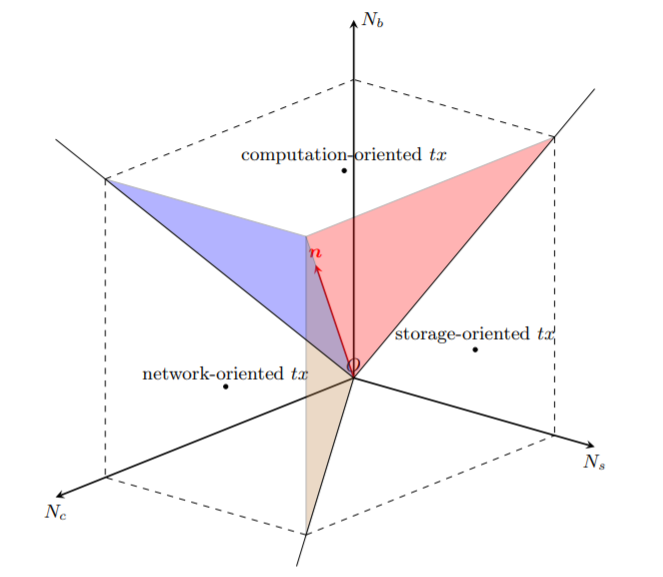
Figure A.

Blockchain Costs

Proof of Work blockchain technology relies on miners to guard the integrity of the blockchain. Miner resources, such as memory and electricity, are costly and therefore a revenue scheme is needed to incentivize miners. Miner incentives are currently comprised of the block rewards and transaction fees. Transactions fees are an important component in preventing spam attacks that exhaust miner resources.

Besides network utilization, transaction processing requires a miner to spend resources to maintain all the original blockchain data. In the case of Bitcoin, this might be less of a problem because it has yet to implement smart contract functionality. Cryptocurrencies that support smart contract languages such as Solidity (Ethereum) however, may require a lot of computations and corresponding costs will be included in the transaction fee.

The 3-dimensional scale shown above is based on storage-oriented load, computational load and network load.

  • Storage-oriented load refers to the additional cost of storing old data in the blockchain. 
  • Computational load is created by the execution of smart contracts. 
  • Network load is all the transactions that do not  exist in the current block but will be added to the next block.

In Ergo, the total size of the state is the sum of the sizes of all UTXOs. That is to say that this data contains the execution of smart contracts, all the transactions and nodal information. Because the memory resources provided by miners are limited, a state deterioration fee should be added to miners' revenue streams in order to encourage decreasing the system load while securing future miners’ contribution.

Storage Rent

Unreasonable state growth is an economic problem and it can lead to spam attacks and network congestion. Another problem could be the deflation of a cryptocurrency if coins are lost and/or forgotten. So instead of being used as the base for smart contracts, the currency becomes unreasonably scarce, making the system heavy and limiting coin flow.

This leads to a perpetually increasing state (e.g. the Bitcoin’s total UTXO size) and the state may grow faster during spam attacks. For example, 15 million outputs were created during spam attacks against Bitcoin in July 2015. An attack on Ethereum created 18 million new accounts added to the state - which previously held only 1 million - and performed successful “denial of service” attacks against the nodes.

To tackle the problem of unreasonable state growth, a "storage rent" fee is proposed by the paper. Storage rent is a scheduled fee that is based on the continuation of each UTXO created in the blockchain. This is achieved by the use of scheduled payments, which will eradicate the unused bytes after a certain time.

Additionally, the use of blockchains as cloud storage is gaining attraction, so permanently storing objects in the state without some form of recirculation procedure of the old data is not a plausible option.

For the purposes of research and this article, it is worth noting that the concept of storage rent was also proposed in 2014 by Freicoin:

“Demurrage forces freicoins to circulate at deliberately high rates. Separation of money's roles as store-of-value and medium-of-exchange allows money to flow when it is needed, in good times and bad. “

Conclusions

An important consequence of storage fees is that they provide additional rewards (besides block and transaction rewards) for miners.

Storage fees decrease the storage load and eliminate extra costs that could be added during unreasonable state growth.

Storage fees encourage coin flow and prevent deflation, which can cause illiquidity and the congestion of a currency system.

Share post
Bene V2 is Here: Multi-Asset Fundraising, Expanded Wallet Support, and Enhanced UI

Bene V2 is Here: Multi-Asset Fundraising, Expanded Wallet Support, and Enhanced UI

The ecosystem of decentralized applications (dApps) on Ergo is constantly evolving.

Ergo Platform

November 28, 2025

Ecosystem Update: Duckpools Rolls Out V2 Site Preview

Ecosystem Update: Duckpools Rolls Out V2 Site Preview

The team behind Duckpools, a prominent lending and borrowing protocol on the Ergo blockchain, has released a comprehensive develop.

Ergo Platform

November 26, 2025

Ecosystem Spotlight: USE, a Universal Stablecoin for Ergo

Ecosystem Spotlight: USE, a Universal Stablecoin for Ergo

With the protocol nearing deployment, the Community Liquidity Bootstrapping (CLB) event is set to begin on November 25th, allowing.

Ergo Platform

November 24, 2025

Rosen Bridge Nears Bitcoin Runes Launch

Rosen Bridge Nears Bitcoin Runes Launch

Rosen Bridge has entered the final phase for its Bitcoin Runes integration. You can now set up your Bitcoin-Runes watcher.

Ergo Platform

November 23, 2025

GitCircles and Ergo: Fair Rewards for Open Source Contributions

GitCircles and Ergo: Fair Rewards for Open Source Contributions

Open source software powers much of the digital world — from the apps on your phone to the infrastructure of the internet itself.

Ergo Platform

October 12, 2025

Bitcoin Runes + Rosen Bridge: A Practical Path for Multi-Chain Fungible Assets

Bitcoin Runes + Rosen Bridge: A Practical Path for Multi-Chain Fungible Assets

The big idea Bitcoin finally has a clean way to represent fungible tokens.

Ergo Platform

September 30, 2025

ChainCash: Money That Carries Its Own Story

ChainCash: Money That Carries Its Own Story

ChainCash records reserves and signatures for each note on Ergo.

Ergo Platform

September 23, 2025

Braiding Lunarpunk and Solarpunk through Merged Mining

Braiding Lunarpunk and Solarpunk through Merged Mining

The question is simple.

Ergo Platform

September 2, 2025

Machina Finance: Off-Chain Execution, On-Chain Trust

Machina Finance: Off-Chain Execution, On-Chain Trust

Machina Finance is an innovative, bot-driven decentralized exchange (DEX) being developed on the Ergo blockchain.

Ergo Platform

September 1, 2025

Ergo Infrastructure DAO: Decentralizing the Backbone of the Ergo Ecosystem

Ergo Infrastructure DAO: Decentralizing the Backbone of the Ergo Ecosystem

Ergo’s mission has always been rooted in decentralization, not just at the consensus layer, but across the entire stack.

Ergo Platform

August 13, 2025

Mew Finance: A Playful DeFi Toolkit for the Ergo Ecosystem

Mew Finance: A Playful DeFi Toolkit for the Ergo Ecosystem

Mew Finance is a decentralized application suite on the Ergo Blockchain.

Ergo Platform

August 12, 2025

Lithos: Decentralizing Mining with On-Chain Pools

Lithos: Decentralizing Mining with On-Chain Pools

Lithos is a new protocol designed to overhaul how mining pools work by moving them on-chain, giving miners full control, and elimi.

Ergo Platform

July 24, 2025

Sigma 6.0: A Smarter, More Flexible Ergo

Sigma 6.0: A Smarter, More Flexible Ergo

Sigma 6.0 is a major proposed upgrade to the Ergo blockchain.

Ergo Platform

July 23, 2025

Shaping Rosen's Future: A Community Call on Five Key Treasury Proposals

Shaping Rosen's Future: A Community Call on Five Key Treasury Proposals

Rosen co-founder, Armeanio, has submitted five new proposals to the Rosen Treasury.

Ergo Platform

July 9, 2025

Ergo's Extended UTXO and the Rise of Artificial Economic Intelligence

Ergo's Extended UTXO and the Rise of Artificial Economic Intelligence

A Practical Vision for Autonomous Economic Agents Autonomous economic agents on the Ergo blockchain perform useful work in a real.

Ergo Platform

May 12, 2025

ErgoHACK X: Artificial Intelligence on the Ergo Blockchain

ErgoHACK X: Artificial Intelligence on the Ergo Blockchain

Celebrating a Decade of Decentralized Innovation Join the 10th anniversary ErgoHACK and be at the forefront of the AI revolution o.

Ergo Platform

April 10, 2025

Ergohack 9: Innovations in UI/UX and Mining – Meet the Visionary Winners!

Ergohack 9: Innovations in UI/UX and Mining – Meet the Visionary Winners!

The latest annual Ergo hackathon, ErgoHack IX, was a six-day event held at the end of October.

Ergo Platform

December 9, 2024

ErgoHack IX: Next Steps Towards Increased Adoption

ErgoHack IX: Next Steps Towards Increased Adoption

We’ve come a long way since the early days of Bitcoin, and cryptocurrencies have boomed into an industry with thousands and thousa.

Ergo Platform

October 20, 2024

Ergo Vs Other Blockchain Platforms: What’s The Difference?

Ergo Vs Other Blockchain Platforms: What’s The Difference?

Ergo offers a series of unique features that set it apart from other blockchain platforms.

Ergo Platform

August 19, 2024

Earning With The Rosen Bridge

Earning With The Rosen Bridge

Bitcoin has officially bridged to the Ergo ecosystem via Rosen Bridge! This newly built, decentralized infrastructure enables trus.

Ergo Platform

August 8, 2024

How Sigma Chains Will Bring Bitcoin To Ergo

How Sigma Chains Will Bring Bitcoin To Ergo

Ergo’s powerful, flexible, and secure smart contract functionality opens the door to a whole host of new use cases for Bitcoin DeF.

Ergo Platform

July 15, 2024