Stablecoins: What Are They and How Do They Work?

Translation temporarily unavailable. Showing original English.
Ergo Platform

2023年5月4日

Stablecoins are a type of cryptocurrency that have their market value pegged to another currency, commodity, or financial instrument. For those who have been active in the cryptocurrency industry, you are no doubt aware of the high volatility of crypto assets. Although they may fuel speculation, it can hinder real-world adoption. With stablecoins, investors can temper their risk exposure with a medium of exchange that is pegged to traditional markets. These assets provide a ‘stable’ currency for everyday transactions.

Today, the stablecoin market is worth about $150 billion and is rapidly growing. However, with massive growth comes the risk of failure. Collapses of widely used stablecoin projects have had significant consequences for the crypto space. With the collapse of Terra’s UST during the 2022 bear market, the contagion had a domino effect across the entire cryptocurrency industry. The rapid growth, and subsequent criticisms, of USDT have garnered increased scrutiny from regulators, especially since stablecoin failures have had a significant impact on broader financial systems.

What Makes a Stablecoin Stable?

Simply put, stablecoins remain pegged to the value of an asset through algorithmic formulas or by maintaining reserve assets as collateral. There are three main types of stablecoins:

Fiat-collateralized stablecoins:

These stablecoins are backed by a reserve of real-world assets, such as U.S. dollars, euros, or gold. These assets are held in a bank or other financial institution and can be redeemed for cash at a rate of 1:1. Examples of fiat-collateralized stablecoins include Tether (USDT), USD Coin (USDC), and Paxos Standard (PAX).

Crypto-collateralized stablecoins:

These stablecoins are backed by a reserve of cryptocurrency assets, such as Bitcoin or Ethereum. These assets are held in a smart contract on a blockchain and can be redeemed for the stablecoin at a rate determined by the value of the collateral. Examples of crypto-collateralized stablecoins include DAI and sUSD.

Non-collateralized stablecoins:

These stablecoins are not backed by any physical assets or reserves. Instead, they rely on complex mathematical algorithms to control the supply of the stablecoin in order to keep its value stable. Examples of non-collateralized stablecoins include Ampleforth (AMPL) and Basis (BAS).

Fiat-Collateralized Stablecoins

The simplest type of stablecoin to comprehend are those that are redeemable for the external reference to which they are pegged. That is, these stablecoins are collateralized 1:1 by fiat. For example, a fiat-collateralized stablecoin pegged to 1 USD can be redeemed for 1 USD fiat. This is less of a peg and more of a digital representation of a dollar, where it requires a centralized custodian to hold the reserve. Not only do you have to trust this custodian, but you also have to trust that auditors ensure the custodian is using best practices to maintain the proper reserves. If the centralized entities in charge of the reserve truly maintain the proper collateral, then fiat-collateralized stablecoins can withstand any amount of cryptocurrency volatility.

Benefits

  • 1:1 price stability through fiat reserves.
  • Simple mechanism that makes it easy to understand.
  • Collateral is held off the blockchain, so this system is less vulnerable to hacks.

Drawbacks

  • Antithetical to the adoption of DeFi - it requires a trusted custodian to manage a fiat reserve (centralized).
  • Expensive and slow to liquidate into fiat.
  • Requires regular audits to maintain transparency and ensure that fiat reserves are maintained.

Tether’s USDT is a stablecoin with the largest market cap (among stablecoins), and is an example of a stablecoin backed by a reserve. Between 2014 and 2017, Tether promoted that USDT was 100% backed by fiat reserves and could be exchanged 1:1 for USD at any time. Since 2017 however, Tether has been embroiled in controversies. In 2019, Tether admitted that their reserves were not backed by fiat, but instead were a mix of “traditional currency, cash equivalents, [and] other assets and receivables from loans made by Tether to third parties, which may include affiliated parties.”

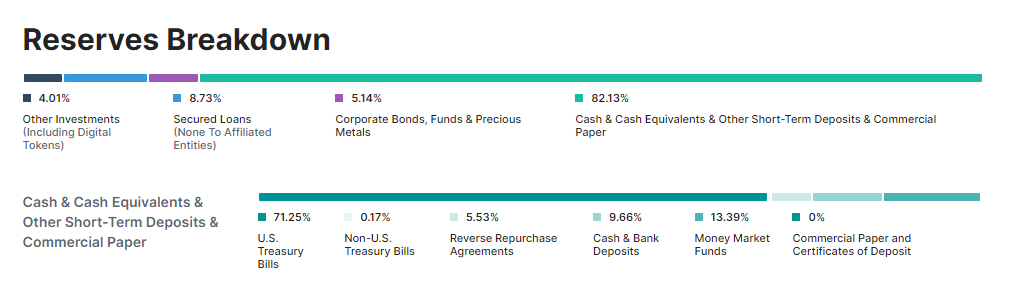
Since then, Tether has disclosed that only ≅8% of reserves were actually held as cash. Tether has also had consistent delays when it comes to the audits on its finances, which were finally completed in December 2022. The current breakdown of Tether Reserves are highlighted in the graphic below:

Tether Reserves Breakdown.png

Unfortunately, the need to trust centralized entities maintains the status quo and handcuffs the crypto industry to the very thing it is trying to evolve away from: traditional finance.

The next two biggest fiat-collateralized stablecoins by market cap are USDC and BUSD. They both have reserves containing mostly US treasury bills and some fiat (<25%), and they advertise that they wish to be transparent with their collateral.

Crypto-collateralized Stablecoins

If a crypto project is committed to DeFi, it stands to reason that the founders of such a project would want to avoid the fiat system and centralization. To have a stablecoin that moves completely away from fiat (but still relies on the concept of reserves), it is possible to use another cryptocurrency as a store of reserve. The problem with this model is that cryptocurrencies have volatile prices, so the value of collateral stored in reserves can be subject to similar fluctuations. The only way to ensure that reserves are sufficient against massive downward price action on the reserve cryptocurrency is to over-collateralize the stablecoin, so it can absorb the significant price fluctuations of the collateral.

An example of a crypto-collateralized stablecoin is DAI, which is issued by the makerDAO project on Ethereum. DAI is pegged to USD and its value is maintained through collateralized debt positions (CDPs).

SigmaUSD is an example of a decentralized stablecoin issuance protocol that uses reserves and is not collateralized by debt positions.

Everyone can mint SigUSD as well as SigRSV (to provide reserve to the platform). This protocol allows people to hold USD backed by Ergo and earn commission fees by locking their ERG as reserve capital. The reserve based model is superior to using collateral debt positions, since it is able to prevent cascading liquidations during extreme volatility of collateral assets.

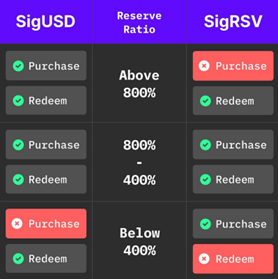
The protocol uses a reserve ratio between 400% and 800% to create healthy liquidity for buyers, sellers and holders. The reserve ratio is the value of SigUSD in circulation to the value of the ERG stored in the reserve. So, if 1000 SigUSD is in circulation and 1000 Erg valued at 5 USD is stored in the reserves, then the reserve ratio is 500%.

You may be wondering, what does it mean to keep the reserve ratio between 400% and 800%? If the reserve ratio is below 400%, then the contract stops users from redeeming SigRSV for the ERG stored within the reserve. By doing so, the protocol can maintain USD and SigUSD parity. Additionally, while the reserve ratio is under 400%, users will not be able to mint SigUSD. If the value of ERG goes up and brings the reserve ratio above 400%, then more SigUSD can be issued. Likewise, if the value of ERG goes down and the reserve ratio is under 400%, then minting of SigUSD will be locked.

This means that if someone mints $100 worth of SigUSD, then there will be $400 worth of SigRSV backing it. This makes it equal to a 75% collateralized debt position. The system protects SigUSD’s peg to USD and prevents flash crashes if the reserve ratio falls below 400%.

unnamed (1).png

Holders of SigRSV benefit from transactions on the protocol. Users who mint or redeem SigUSD pay a 2.25% fee, which goes to the reserve holders.

Non-Collateralized Stablecoins

Non-collateralized stablecoins are also known as algorithmic, seigniorage-style stablecoins or future-growth-backed stablecoins. These stablecoins do not rely on collateral assets to maintain their value, but instead use mathematical algorithms to control the supply of the stablecoin to keep its value stable. Dexy is an example of a seigniorage-style stablecoin.

The Dexy protocol uses ERG as the reserve and Dexy as the stablecoin. There are two contracts that function together: a bank and a DEX (CP-AMM). The bank holds the reserves for deployment and mints new Dexy into the DEX. The DEX attempts to maintain an oracle price and has buy and sell functions.

The first product being built with the Dexy framework is DexyGold, where the price of the stablecoin is pegged to the USD/XAU v2 oracle pool. Dexy uses a one-way tethering mechanism, where the Dexy tokens are minted from an emission contract based on the oracle pool rate, and can be sold on a Liquidity Pool (LP), similar to Uniswap V2. To ensure the stability of the protocol, the redeeming of LP tokens is not allowed when the oracle pool rate is below a certain percent of the LP rate.

If the oracle pool rate is higher than the LP rate, then traders can arbitrage by minting Dexy tokens from the emission box and selling them to the LP. If the oracle pool rate is lower than the LP rate, then the ERG collected in the emission box can be used to bring the rate back up by performing a swap.

Beyond Stablecoins: Peer-to-Peer Money

ChainCash is a decentralized, peer-to-peer monetary system that aims to create money collectively through trust and blockchain assets. It addresses the issue of inelasticity in blockchain asset supply, which can hinder their real-world usage. Chaincash allows for the elastic creation of money in a decentralized manner, while maintaining the quality of the currency.

Users of ChainCash can create notes of arbitrary values, which may or may not be backed by reserves in various digital tokens or real-world assets. These notes are like digital representations of money that can be used for transactions within the ChainCash system. To maintain the quality of the currency, the acceptance of a note depends on the collateral or trust in the issuer. As notes circulate, their quality generally improves due to the collective collateral and trust backing them.

The implementation of ChainCash will use two contracts: one for notes and one for reserves. The system can track different note and reserve contracts, support various acceptance predicates and redemption mechanisms, and accommodate complementary currency systems, such as Local Exchange Trading Systems (LETS) and local currencies.

While Layer Two implementation is still being considered, ChainCash offers a flexible and decentralized monetary system that has the potential to cater to different economic agents globally, addressing the limitations of traditional blockchain assets.

Conclusion

Stablecoins are a vital part of the cryptocurrency industry because they act as a bridge, integrating traditional finance with the new blockchain-based crypto systems. Even though the SigUSD protocol has been incredibly successful, developers on Ergo continue to innovate the potential designs of a crypto stablecoin. Currently, two major financial frameworks are being developed: Dexy and ChainCash. With the development of cross-chain bridges (such as Rosenbridge), Ergo’s stablecoins have the potential to offer many other blockchain users a secure and stable store of value - one the industry desperately needs.

Share post

Ergo基础设施DAO:去中心化Ergo生态系统的支柱

Ergo基础设施DAO:去中心化Ergo生态系统的支柱

Ergo的使命一直根植于去中心化,不仅在共识层面,而是在整个技术栈中。随着Ergo基础设施DAO (InfraDAO)的推出,这一愿景正在扩展到每天为生态系统提供动力的服务和基础设施。 InfraDAO现在在Paideia上正式上线,经过成功的治理投票。最初.

Ergo Platform

2025年8月13日

Mew Finance:一个为Ergo生态系统提供的有趣DeFi工具包

Mew Finance:一个为Ergo生态系统提供的有趣DeFi工具包

Mew Finance是一个基于Ergo区块链的去中心化应用套件。该项目于2024年10月启动,将DeFi、数字资产和跨链功能整合到一个统一的平台中。长期社区开发者HQΣr和Aco Šmrkas领导该项目。设计上偏向模块化、易用性和深度生态系统集成。 本文是.

Ergo Platform

2025年8月12日

Lithos:通过链上矿池实现去中心化挖矿

Lithos:通过链上矿池实现去中心化挖矿

Lithos是一个新协议,旨在通过将矿池转移到链上来彻底改革矿池的运作方式,使矿工完全控制,并消除对中心化矿池运营商的需求。与之前大多数去中心化挖矿的尝试不同,Lithos旨在高效、可扩展和安全。 什么是Lithos? Lithos是一个去中心化的矿池协议.

Ergo Platform

2025年7月24日

Sigma 6.0:更智能、更灵活的Ergo

Sigma 6.0:更智能、更灵活的Ergo

Sigma 6.

Ergo Platform

2025年7月23日

塑造Rosen的未来:关于五项关键财政提案的社区呼吁

塑造Rosen的未来:关于五项关键财政提案的社区呼吁

Rosen的联合创始人Armeanio已向Rosen财政提交了五项新提案。这些提案概述了Rosen Bridge的增长、实用性和可扩展性的战略愿景,这是Ergo互操作性基础设施的核心组成部分。 这是Ergo社区审查和讨论这一重要跨链服务未来方向的关键时刻。以.

Ergo Platform

2025年7月9日

Ergo的扩展UTXO与人工经济智能的崛起

Ergo的扩展UTXO与人工经济智能的崛起

自主经济代理的实用愿景 Ergo区块链上的自主经济代理在真实的数字经济中执行有用的工作。它们通过创建内容和提供数据分析、模式识别等服务来产生收入。它们利用收入支付运营费用,如托管费和服务器成本,并使用现代工具,如SSH和加密友好的托管服务提供商。当有额外资金.

Ergo Platform

2025年5月12日

ErgoHACK X:在Ergo区块链上的人工智能

ErgoHACK X:在Ergo区块链上的人工智能

庆祝去中心化创新的十年 加入第十届ErgoHACK,站在Ergo区块链AI革命的最前沿!释放你的创造力,与其他创新者合作,共同构建去中心化AI的未来。 关于ErgoHack ErgoHACK,旗舰社区黑客马拉松,庆祝其十周年!这一里程碑事件是Ergo生态系统.

Ergo Platform

2025年4月10日

ERG正式上线Kucoin(库币)交易所

ERG正式上线Kucoin(库币)交易所

据Kucoin官方通告,Ergo平台原生代币ERG于8月3日正式上线Kucoin(库币)交易所。目前支持的交易对是ERG/USDT。现已开放充值;2021年8月5日UTC时间上午10:00开放交易;2021年8月6日UTC时间上午10:00开放提币。 .

Ergo Foundation

2021年8月3日

Ergo两周年纪念——早期采用者应了解的核心知识

Ergo两周年纪念——早期采用者应了解的核心知识

Normal 0 false false false EN-US ZH-CN X-NONE /* Style Definitions */ table.

root7Z

2021年7月5日

关于Ergo启用官方QQ频道的公告

关于Ergo启用官方QQ频道的公告

由于Ergo官方微信号暂无法使用,Ergo官方现新增Ergo官方QQ频道:796039547。全球中文用户可通过扫描下面的二维码加入Ergo中文社区,及时了解Ergo最新官方动态. .

Eva Qing

2021年6月30日

Ergo首届黑客松大赛ERGOHACK圆满结束

Ergo首届黑客松大赛ERGOHACK圆满结束

Ergo首届黑客松大赛已经圆满结束,它正如计划那样:规模小而富有实验性,但依然收到了一些很棒的作品提交。Kushti以他的开场视频拉开了活动的序幕,然后我们总共有六个团队,其中来自anon_real(AuctionHouse、SigmaUSD UI等项目的创建.

Curia Regis Crypto

2021年6月29日

关于举办首届Ergo中国社区驱动践行活动的公告

关于举办首届Ergo中国社区驱动践行活动的公告

为了进一步提高Ergo公链平台在中国的知名度,让更多用户深入了解Ergo,同时为了践行Ergo社区驱动的理念,Ergo中国社区现特别举办“首届Ergo中国社区驱动践行活动”。活动参与者积极向新用户布道Ergo并将其引至Ergo官方指定社群,将有机会赢取ERG奖.

Eva Qing

2021年6月4日

比特币的前进之路是努力追赶Ergo ——Ergo率先实现扩展UTXO智能合约

比特币的前进之路是努力追赶Ergo ——Ergo率先实现扩展UTXO智能合约

比特币 比特币是一头野兽。是的,其底层软件需要认真升级。它真的太慢了。但是,您也必须承认它的优势,网络效应是非常强大的------比特币是加密货币之王。在全球范围内,比特币正成为一个常见、被理解和被采用的术语。大型信托、投资巨头和对冲基金经理,都被比特币的主.

Curia Regis Crypto

2021年5月23日

关于Ergo基金会任命谭声情先生担任中国区大使的公告

关于Ergo基金会任命谭声情先生担任中国区大使的公告

经Ergo基金会批准,现任命谭声情先生(英文名:Tango)担任Ergo中国区大使。 为了提升Ergo在中国的知名度与影响力,Ergo基金会现授权谭声情先生以Ergo中国区大使身份进行Ergo在中国的品牌宣传、商务洽谈、社区活动、主题推广等事宜。 此任命自.

Ergo Team

2021年5月16日

硬分叉事后说明

硬分叉事后说明

英文链接: 应@kushti的请求,我现在给大家说明一下今天在硬分叉升级期间发生的事情。有一些BUG导致矿工无法出块,现已修补好这些BUG,矿工可以出块。 version2ActivationDifficultyHex中出现往返编码失败(Round-T.

Eva Qing

2021年2月3日

硬分叉升级后Ergo挖矿须知

硬分叉升级后Ergo挖矿须知

Ergo将在区块#417,792上进行硬分叉协议升级。此次升级会引入重大更改,包括将关闭不可外包功能(Non-Outsourceability)。经过此次硬分叉之后,新的PoW(被称为Autolykos v2.

Eva Qing

2021年2月1日

如何设置和配置Ergo全节点

如何设置和配置Ergo全节点

如何设置和配置Ergo全节点 本教程说明了如何安装和运行Ergo全节点,不涵盖挖矿。  Windows用户还可以观看视频教程。 如何在Windows上设置和配置Ergo全节点 视频链接: 节点安全 这里是节点使用的一些重要方面,您的钱包及代币是否安全.

Eva Qing

2021年1月21日

既想享受乐趣,又想赚取利润? ——那就赶紧来挖ERG

既想享受乐趣,又想赚取利润? ——那就赶紧来挖ERG

Ergo GPU挖矿 本文将帮助您开始使用GPU挖矿Ergo原生代币ERG。 Ergo挖矿基于Autolykos,即一种工作量证明(PoW)算法,被设计为阻碍ASIC矿机和矿池。矿工须执行存储困难的计算(需要至少4 GB的内存,但是当前最有效的实现使用的是.

Eva Qing

2021年1月21日

适用于AMD GPU的Autolykos v2(Ergo)的OpenCL挖矿软件

适用于AMD GPU的Autolykos v2(Ergo)的OpenCL挖矿软件

适用于ergoplatform.

Eva Qing

2021年1月19日

适用于Nvidia GPU的Autolykos v2(Ergo)用Cuda挖矿软件

适用于Nvidia GPU的Autolykos v2(Ergo)用Cuda挖矿软件

用于ergoplatform.

Eva Qing

2021年1月19日

尔格基金会为主要去中心化应用(dApp)基础设施提供资助

尔格基金会为主要去中心化应用(dApp)基础设施提供资助

尔格基金会将考虑支持重大生态系统开发项目提供资助的建议。 尔格是一个面向社区的项目,该生态系统的方方面面都有许多贡献者。尔格基金会会拿出一部分资金资助此项工作,这对于构建用户所需的日常产品与服务以及更多样化的金融去中心化应用至关重要。该基金会正在积极寻求.

Guy Brandon

2020年11月17日