Everything You Need to Know About Proof of Work

Translation temporarily unavailable. Showing original English.
Ergo Platform

2024年1月4日

If you are new to cryptocurrency, you undoubtedly have numerous questions. You have probably heard of Bitcoin, and maybe even consensus mechanisms, but what do they mean and how do they impact the user experience of cryptocurrencies? In order to have confidence in accessing this emerging technology, it is important to have a basic understanding of how blockchains are constructed, maintain security, and offer a new economic avenue for business without 3rd party intermediaries. This new industry all started with the advent of Bitcoin, so we will start with a look at Bitcoin’s Proof-of-Work consensus model.

Understanding Proof-of-Work (PoW)

Proof-of-Work (PoW) mining is a network consensus mechanism. It is a process by which all of the different nodes (members) of a blockchain network reach agreement about the contents of the ledger, whereby no single node is in charge.

Consensus mechanisms are what enable cryptocurrency users to make payments directly between each other, without any trusted third parties. PoW is the earliest such mechanism, and has been in existence as long as Bitcoin (January 2009). Since that time, many different variations on PoW blockchains have been launched, offering different trade-offs in terms of cost, security, and accessibility.

The basic premise of PoW is that network nodes compete to solve a mathematical problem that requires a large amount of computational resources, thus the need for electricity and sometimes specialized hardware. This significant investment by miners is only worthwhile because they are rewarded for the service they provide to the network. These payments include new coins and network transaction fees, which are generated with each new block that is added to the blockchain.

It makes sense for miners to agree with the honest majority of the network, since fraudulent transactions will be ignored and they will have wasted resources. The only way for a miner to succeed in being dishonest is to control more than 50% of the network’s computational resources, which would be prohibitively expensive.

Key Features of Proof-of-Work

Security

The worth of a blockchain network is measured by the strength of its security. In the case of PoW, this consensus mechanism enhances blockchain security because of the complex mathematical puzzles that the miners are required to solve. Essentially, these puzzles are hurdles put in place to deter potential attackers.

The decentralized nature of PoW, via widely distributed miners, reduces central points of failure in the network. Since running a Proof-of-Work blockchain is an energy-intensive process, this makes it inherently resistant to 51% attacks, contributing to the overall security and integrity of the network.

Energy Usage

When discussing Proof-of-Work, it is important to address the number one concern for this kind of consensus mechanism: energy consumption.

Contrary to popular belief, the energy consumption of PoW is not an insurmountable problem. In fact, it can be argued that there is no issue with this kind of energy usage when compared to the consumption of other tech industries. Studies indicate that the energy usage of PoW chains is comparable to, or even less than that of data centers utilized by many of today’s tech giants. The notion that PoW is excessively energy-intensive is not only wrong, but also harmful to the growth and dissemination of this potentially revolutionary technology.

While estimates place cryptocurrency mining energy consumption at 110TWh, global data center consumption is more than double, sitting somewhere in between 240-340 TWh. In the context of annual global energy consumption, cryptocurrency mining demands a measly 0.4%.

It is also important to note that a large percentage of cryptocurrency mining, such as Bitcoin, is taking place on renewable energy systems, such as solar, wind, and even geothermal energy. The latest reports estimate that, in the case of Bitcoin, renewable energy sources used to mine the currency are now above 50%.

Despite what some in the mainstream media would have you believe, the reality is that PoW electricity consumption is not nearly as bleak as headlines make it out to be.

Proof of Work Cryptocurrencies

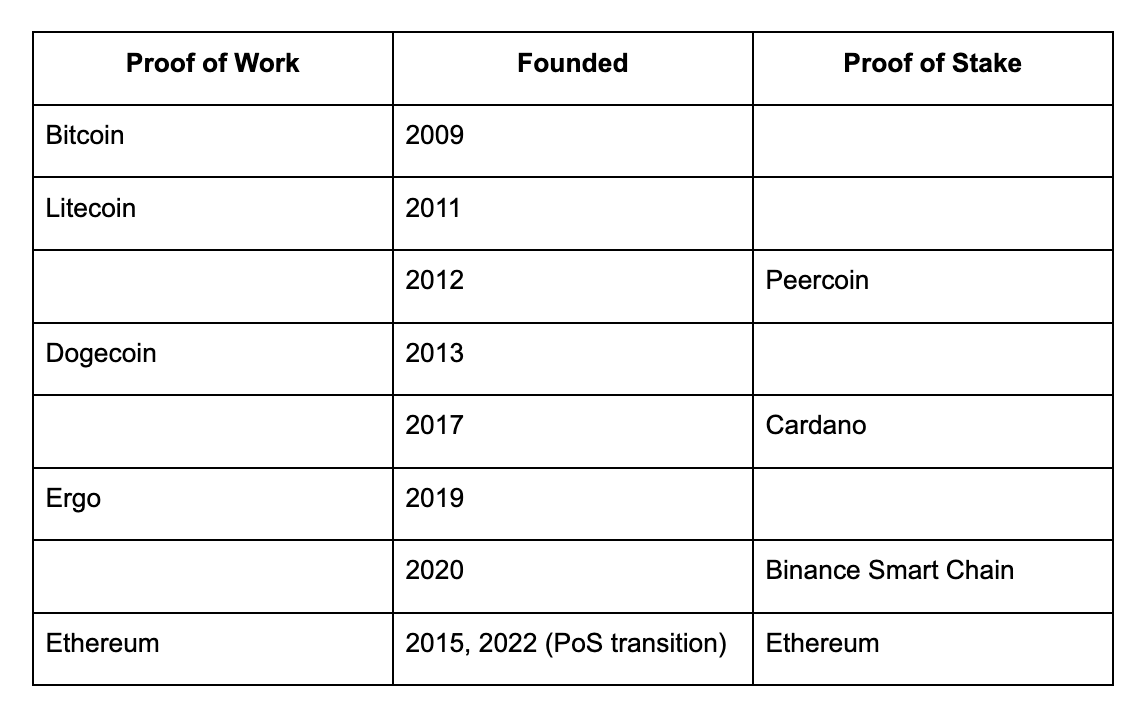
While Ethereum might have transitioned from PoW to Proof-of-Stake (PoS), other chains have maintained their original approach to PoW network consensus.

Here are five PoW coins, and some of the reasons why they have opted for this consensus mechanism.

Bitcoin

  • Price: $42,000
  • Market cap: $800 billion
  • Max. supply: 21 million BTC
  • Block time: 10 minutes

Bitcoin was the original cryptocurrency and the trailblazer for PoW mining. Satoshi Nakamoto’s use of Adam Back’s HashCash algorithm enabled them to create a system in which it is difficult for a network participant to add transactions to the blockchain, but trivially easy for anyone to check them. This makes it both expensive and pointless to attempt to submit a fraudulent transaction, since it will be ignored by the honest majority of the network.

Proof of Work mining did not just solve the Double Spend Problem (also known as the Byzantine Generals Problem): The puzzle of how to coordinate a large network of participants who do not know or trust each other, ensuring that the contents of the Bitcoin ledger are agreed upon by the vast majority. PoW mining also solved the issue of how to distribute coins.

When new enterprises are launched in the TradFi world, an organization is typically split into shares, which are sold or otherwise distributed to initial holders. This model has been replicated by many crypto projects in recent years. However, the invention of PoW mining allowed Satoshi to distribute coins only to those who supported the project by securing the network (mining). This is more like the process by which gold is distributed than conventional assets.

Bitcoin miners have collectively invested hundreds of millions of dollars in the hardware used to secure the network. Moreover, Bitcoin secures billions of dollars of value and its core community is highly conservative, recognizing the risks of making unnecessary changes to the protocol. Bitcoin has used the same PoW algorithm since its inception 15 years ago, and there is no prospect of that changing.

Litecoin

  • Price: $73
  • Market cap: $5 billion
  • Max. supply: 84 million LTC
  • Block time: 2.5 minutes

Litecoin (LTC) was launched in October 2011 by Charlie Lee, also known as Satoshi Lite. Lee wanted to adjust the Bitcoin Protocol to create a new crypto with different properties. For example, Litecoin has a 2.5 minute block time (Bitcoin has 10-minute blocks), and a total supply of 84 million (Bitcoin has 21 million).

Lee also changed the PoW mining algorithm, using Scrypt instead of SHA256. Based on a different “hash” function (which provides a unique digest or “fingerprint” for a chunk of data), Scrypt aims to be suited to parallel processing, making it more ASIC-resistant when compared to SHA-256. With its faster transactions and greater accessibility to miners, Litecoin was positioned as the “silver to Bitcoin’s digital gold.”

Because Litecoin was released soon after Bitcoin, and before other consensus mechanisms were developed, it uses PoW by default – albeit a different version to Bitcoin.

Dogecoin

  • Price: $0.09
  • Market cap: $12 billion
  • Max. supply: Infinite
  • Block time: 1 minute

Dogecoin (DOGE) is another early cryptocurrency. Although Proof-of-Stake (PoS) had been developed by the time it was launched in December 2013, creators Billy Markus and Jackson Palmer decided to deploy Dogecoin as a PoW network. The reason being was that Dogecoin was forked from an existing crypto called Luckycoin, which itself was a fork of Litecoin.

Dogecoin launched as a fun meme-based crypto, and from the outset, sought to attract a large and vibrant community, rather than seek technical innovation. As such, it simply relied on existing technology for simplicity and speed of development and reliability. There was no need to try anything new.

Although there have been discussions about Dogecoin shifting to PoS in recent times – particularly since Elon Musk took an interest in the coin – this has not yet happened.

Monero

  • Price: $170
  • Market cap: $3 billion
  • Max. supply: 18.4 million plus ongoing “tail emissions” of 0.6 XMR/block
  • Block time: 2 minutes

Another relatively early coin that used PoW and has stayed the distance is Monero. Launched in April 2014, Monero is a privacy-oriented crypto that uses ring signatures to obscure the participants of a transaction.

By this stage, Proof of Stake was becoming better established, and a number of platforms had implemented it, including Peercoin (which launched in August 2012 and used a combination of PoW and PoS) and Nxt (a pure PoS coin launched in November 2013). However, it was important to the Monero developers that there should be no ‘premine’ or ‘instamine’ – that is, all coins should be distributed fairly, following the official launch, so that anyone in the crypto community could participate in mining them.

They therefore opted to use PoW. In this case, Monero’s mining process used RandomX, a resource-efficient Proof-of-Work (PoW) algorithm optimized for general-purpose CPUs. Like Litecoin, the aim of using this algorithm was to prevent mining becoming concentrated in the hands of a relatively small number of users who could afford large mining rigs. The process of finding ASIC-resistant mining algorithms had become a continual arms race, and by this point, the first Litecoin ASICs had been developed and were being commercially released.

Ergo

  • Price: $1.40
  • Market cap: $100 million
  • Max. supply: 97,739,924 ERG
  • Block time: 2 minutes

As time went on, more and more blockchain platforms launched with PoS. There were several reasons for this:

  • PoW’s perceived environmental reputation, due to its high energy use.
  • Project developers were increasingly conducting ICOs to fund platform development, and selling some or all of the coin supply to investors, meaning that an initial distribution mechanism was not required.
  • Potentially a wider pool of users to maintain the network could be attracted through PoS, since staking does not require specialist hardware.

When Ergo launched in 2019, it unashamedly opted for a PoW consensus model for very important reasons. Ergo utilizes the Autolykos algorithm for its proof-of-work (PoW) algorithm. Autolykos is designed to be memory-hard, meaning it requires a significant amount of memory to perform the mining process, again making it much less susceptible to being efficiently mined by specially-designed ASICs. The aim, as with similar approaches in the past, was to promote a more decentralized and accessible mining ecosystem.

Moreover, Ergo had NO premine, NO ICO (initial coin offering), and NO VC (venture capitalists) or other early investors. Every coin that exists was created by mining – ensuring that right from the outset, distribution was as fair as possible (like Bitcoin). The consensus algorithm is much more energy efficient when compared to the energy consumption of previous PoW blockchains.

As a platform that offers powerful (but optional) privacy features, and that places a high emphasis on censorship resistance, PoW is an important element of the Ergo network. Because mining rigs are physically distributed around the world (rather than being hosted in data centers on VPSs (many of which are maintained by a small number of providers like AWS and Digital Ocean), there is a high degree of decentralization. This reduces the possibility that one provider will be a single point of failure, and that transactions might be censored or otherwise tampered with.

Lastly, PoW has a track record as long as cryptocurrency itself. Ergo has always taken a conservative approach to core platform infrastructure, while releasing cutting-edge features on this rock-solid foundation.

Advantages and Challenges of Proof-of-Work

One of the primary advantages of PoW lies in its ability to ensure network security through an ingenious mechanism that requires participants, known as miners, to solve complex mathematical puzzles to validate transactions.

This intricate process demands significant computational power, deterring malicious actors from attempting to manipulate the blockchain. The sheer computational effort required not only secures the network against attacks but also creates a level playing field for miners, fostering a decentralized environment.

Furthermore, PoW incentivizes miners to contribute their computational resources to the network by rewarding them with newly minted coins for successfully solving puzzles. This reward system serves two purposes: motivating miners to continue participating, and distributing newly created coins in a fair and transparent manner.

As for the future of PoW, this involves ongoing efforts to address its challenges and enhance its sustainability. Innovations such as energy-efficient mining hardware and a growing focus on renewable energy sources showcase the commitment of the PoW community to mitigate environmental concerns.

Delving into Proof-of-Stake (PoS)

A newer consensus mechanism, Proof-of-Staken (PoS), has been becoming increasingly popular in the cryptocurrency industry as of late. This is in no small part thanks to Ethereum, the number 2 most popular and traded cryptocurrency, which recently transitioned to PoS from PoW.

Other popular PoS cryptocurrencies include the likes of Solana (SOL), Cardano (ADA), Polygon (MATIC), and most recently Toncoin (TON).

What is Proof-of-Stake (PoS)?

PoS is a consensus mechanism used in blockchain networks to validate transactions and create new blocks. This consensus mechanism draws some similarities to PoW, but is often recognized for its lower energy consumption.

As a result, PoS is widely regarded as the greener, more efficient, and lower barrier-to-entry consensus mechanism.

How does Proof-of-Stake (PoS) work?

Similar to PoW, this consensus mechanism is used to secure and validate blockchain networks. However, this is where the similarities end.

Unlike PoW however, this PoS consensus mechanism relies on what are known as validators, who lock up a predetermined amount of cryptocurrency as a collateral, in order to generate new blocks. In Ethereum’s case, validators must lock up, or stake, a minimum of 32 ETH tokens to participate in securing the network.

The network selects validators based on a number of criteria, such as stake size and time spent staking.

These criteria differ based on the blockchain network. In the case of PoS, what keeps validators from turning into bad actors is the slashing mechanism. That is, if a validator is found to be a bad actor (i.e. attempting to manipulate the network), their staked tokens are taken away from them to either be burned or distributed amongst other validators.

Lastly, a PoS network incentivizes its validators to continue staking their tokens by receiving network transaction fees each time they are picked to validate a new block.

Why did Ethereum switch to Proof-of-Stake (PoS)?

So, if PoW is widely regarded as the great mechanism that gave rise to Bitcoin, then why did Ethereum switch to a new consensus mechanism?

Ethereum's transition to PoS was driven by a desire to address environmental concerns related to PoW. According to Vitalik Buterin, the founder of Ethereum, this new consensus mechanism would quell environmental concerns over the scalability of cryptocurrency, and is the “solution to the environmental issues of Bitcoin – which needs far less resources to maintain”.

Other arguments for Ethereum’s switch to PoS were also put forth, with considerations for security and decentralization. However, PoS is not necessarily more secure than PoW. For both consensus models, a 51% attack would be impossible, as it would require the bad actor to either control the entire energy grid of a small nation, or own an unfathomable amount of ETH tokens.

Benefits and Limitations of Proof-of-Stake

Now that we’ve explored Proof-of-Stake, what it is, and how it works, let’s lay out a comprehensive list of the benefits and limitations of the consensus mechanism.

Benefits

Environmental Friendliness

Proof-of-Stake (PoS) stands out for its environmentally friendly approach compared to Proof-of-Work (PoW). By eliminating the need for resource-intensive mining processes, PoS drastically reduces energy consumption. This eco-friendly characteristic addresses growing concerns about the environmental impact of blockchain networks, making PoS an attractive choice for those who care about energy sustainability.

Lower Entry Barriers

PoS offers a lower barrier to entry for participants. Unlike PoW, which demands expensive hardware and high electricity costs, PoS validators only need to lock up a predetermined amount of cryptocurrency.

Energy-Efficient Validation

The validation process in PoS relies on validators staking a predetermined amount of cryptocurrency, which is less energy-intensive when compared to PoW's complex mathematical puzzles. This energy efficiency not only contributes to environmental sustainability but also facilitates a smoother and faster validation mechanism.

Reduced Centralization Risks

Some argue that PoS systems mitigate the risk of centralization that can arise from concentrated mining power. While PoW networks might face challenges with large mining pools, PoS distributes influence based on the amount of cryptocurrency staked.

Limitations

Staking Centralization

Since validators need to stake a certain amount of cryptocurrency, there is a concern that those with significantly larger amounts of the currency possess greater influence over the network. If a small number of holders control a large portion of the cryptocurrency, it may undermine the intended decentralization benefits of PoS.

Security Reliance on Financial Stake

The security of PoS networks heavily relies on validators (stakers or stake pools) having a significant financial stake in the cryptocurrency. While this aligns economic incentives with network integrity, it also introduces the risk of a well-funded attacker gaining control. The network’s slashing mechanism, which penalizes malicious behavior, serves as a countermeasure, but it requires continuous vigilance to maintain network security.

Complexity in Slashing Mechanism

That same slashing mechanism that is designed to discourage malicious behavior, adds a layer of complexity to the consensus model. Determining when and how to penalize validators involves careful consideration, and any flaws in this mechanism could compromise the security of the PoS network. Ongoing research and development are essential to refining and improving the effectiveness of the slashing mechanism.

PoS offers distinct advantages in terms of environmental sustainability, accessibility, and energy efficiency. However, challenges related to initial wealth distribution, potential staking centralization, security reliance on financial stake, and the complexity of the slashing mechanism highlight areas that require ongoing attention and refinement within the PoS consensus model. As the blockchain landscape continues to evolve, addressing these limitations will be crucial for PoS to fulfill its promise as a secure and sustainable consensus mechanism.

An Overview and Comparative Analysis: PoW Vs PoS

PoW and PoS are the two most popular consensus mechanisms for blockchain networks. While they are both used to secure cryptocurrency transactions, they work in very different ways, and have different strengths and weaknesses. Ultimately, neither is the “best” approach, but depending on the use case, one consensus model might be more suited to certain applications and projects.

Validation

In PoW, miners compete to solve complex mathematical puzzles (hashes). The first miner to solve the puzzle broadcasts the solution, and the block is added to the blockchain.

PoS replaces miners with validators, or stakers. The next validator is chosen to create a new block based on the amount of cryptocurrency they have staked or locked up as collateral. The process is broadly random, but the more they stake, the greater their odds of being selected.

Energy Consumption

PoW miners usually need powerful hardware to secure the network (including GPUs or specialist ASIC mining rigs). These require a larger amount of electricity to operate.

PoS uses far less energy than PoW, since it does not require specialist hardware. Validating nodes can typically be run on an ordinary consumer VPS.

Security

In a PoW system, an attacker would need more than 50% of the total network hashrate (computational resources) to successfully process fraudulent transactions. This is quite difficult to achieve because of the exorbitant cost of energy and hardware.

In a PoS system, the attacker would need a significant financial stake in the network. Acquiring the necessary coins for this stake would drive up the price of the cryptocurrency, and the cost would potentially far outweigh the benefits. As we mentioned earlier, slashing mechanisms commonly penalize malicious behavior by “slashing” a portion of the validator's stake.

Decentralization

The decentralization of a PoW network depends on the number of miners, their distribution,, and the amount of hashrate they control. PoW systems tend to be decentralized, although the existence of mining pools can create single points of failure.

PoS networks can also achieve a high level of decentralization, but large staking pools and uneven distribution of coins can pose a problem if a few holders control a significant amount of the crypto.

Incentives

PoW miners are paid with newly-created cryptocurrency (block rewards) and transaction fees for successfully adding a block to the blockchain. In most PoW systems, block rewards reduce over time, typically on a halving schedule. As block rewards reduce, typically this has led to an increase in the value of the cryptocurrency.

In PoS networks, validators are rewarded with transaction fees and, in some cases, block rewards. Rewards are typically lower because, unlike PoW miners, PoS stakers do not have high costs. The amount of coins distributed is typically proportional to the validator's stake.

Снимок экрана 2024-01-05 в 15.52.06.png

Ultimately, the decision whether a network is secured by PoW or PoS depends on the goals and values of the platform, its developers, and community. Each consensus mechanism has its own strengths and trade offs. Both PoW and PoS are the subjects of ongoing research that aim to maximize the security, efficiency, and sustainability of blockchain networks.

The Future Of PoW

The majority of new blockchain platforms use some form of PoS as a consensus mechanism. Nonetheless, PoW has a strong future ahead of it. Bitcoin is unlikely to ever change to PoS, and other PoW coins like Litecoin and Dogecoin remain highly popular. Moreover, as mentioned earlier in this article, PoW has advantages that make it particularly suited to certain applications, and its environmental costs have been overstated.

The future of PoW mining depends on developments in various different areas, including the technological and regulatory spheres.

Hardware and technology

PoW mining has always been an arms race to gain the maximum hashrate for the minimum electricity cost. We can expect this process to continue, as manufacturers produce ever-more efficient mining chips. This will likely increase the competitiveness and sustainability of PoW mining, reducing concerns about energy use.

Additionally, the development of new mining algorithms (or even whole new consensus mechanisms), such as Ergo’s Autolykos, have th e potential toredefine the current landscape of PoW mining.

Environmental concerns

The ongoing debate around Bitcoin and PoW mining is evolving quickly. Following some bad publicity, new studies have shown that Bitcoin mining has become dramatically more energy efficient in recent years, as miners have sought to use cheap renewable electricity. In fact, miners are helping to drive clean energy use, and Bitcoin mining uses more sustainable power than any other major industry in the world (including the electric vehicle industry). This trend is set to continue. Additionally, there is growing discussion about Bitcoin’s role in helping to manage and stabilize the energy grid, with miners being in a unique position to help balance loads at times of peak or low demand. Public perception will be critical in this regard, with powerful interests existing on both sides of the divide and promoting different narratives.

Regulatory developments

Some countries and jurisdictions may harden their stance against PoW mining, and even ban it altogether (as the EU considered doing, ultimately unsuccessfully). Alternatively, they may embrace PoW mining due to the resources at their disposal and opportunities it offers, as is the case with El Salvador and some parts of Texas.

Such developments will depend on the circumstances of each jurisdiction, as well as the overall narrative and information available about the energy use of PoW cryptos. Realistically, though, as we have seen in the past, when mining is banned in one place, miners will simply move to a more favorable location.

Security

PoW provides Bitcoin with robust security due to the enormous amount of computational power that underpins the network. Blockchains secured by small amounts of hashrate may be more vulnerable to attacks, as has been the case in the past (notably with Ethereum Classic). Further attacks of this type would likely tilt the balance in favor of PoS for new blockchain platforms.

Equally, a successful attack of one kind or another on a PoS chain would make a stronger case for PoW mining. PoW’s security features and decentralization may continue to make it the preferred choice for certain blockchain networks (including Ergo).

Other platforms may explore the benefits of hybrid consensus models that combine elements of both PoW and PoS to leverage the strengths of each. Many in the industry view interoperability to be the future of blockchain technology. Ergo’s recent release of the Rosen Bridge, is an indicator of what that future may look like. Rosen Bridge is positioned to utilize Ergo’s strong security features to secure a cross chain bridge that will perform all of the smart contracts on the Ergo side only. The design of this new product will allow users to swap native assets directly with multiple blockchains, including Cardano, Bitcoin, Ethereum, Binance Smart Chain, and Dogecoin.

Transition to PoS

Following Ethereum’s lead, it may be that some PoW blockchains may seek to transition to PoS. Bitcoin is never likely to go down this route, but there have already been discussions about other cryptos, including DogeCoin.

Moving to PoS is a contentious issue, since it would disenfranchise miners, change the security model, and likely split a community – forking the blockchain and creating two separate cryptocurrencies. Although it still faces issues post-Merge, the fact that Ethereum successfully navigated the transition is a testament to the planning and communication that led up to the change over the course of several years.

Conclusion

There are numerous pros and cons for Proof of Work and Proof of Stake consensus mechanisms. By all rights, the cryptocurrency industry is still in its infancy, until we see mass adoption, it will be difficult to imagine what the future of blockchain functionality will look like. Since the inception of Bitcoin, the industry has seen an influx of influencers and blockchain maximalists who proclaim why their preferred cryptocurrency is the only asset we need for the future. This sort of thinking is representative of a narrow view on economy, technology, and the future. If any of these technological wonders are to achieve mainstream status, it will be through an interoperable mindset. Proof of Stake and Proof of Work both offer individual strengths, and product developers would be wise to explore cross-chain products that allow them to exploit the strengths of both consensus mechanisms. An interoperable blockchain future presents a chance to challenge the traditional financial systems and offer people a transparent and secure model for doing business.

Share post

Ergo基础设施DAO:去中心化Ergo生态系统的支柱

Ergo基础设施DAO:去中心化Ergo生态系统的支柱

Ergo的使命一直根植于去中心化,不仅在共识层面,而是在整个技术栈中。随着Ergo基础设施DAO (InfraDAO)的推出,这一愿景正在扩展到每天为生态系统提供动力的服务和基础设施。 InfraDAO现在在Paideia上正式上线,经过成功的治理投票。最初.

Ergo Platform

2025年8月13日

Mew Finance:一个为Ergo生态系统提供的有趣DeFi工具包

Mew Finance:一个为Ergo生态系统提供的有趣DeFi工具包

Mew Finance是一个基于Ergo区块链的去中心化应用套件。该项目于2024年10月启动,将DeFi、数字资产和跨链功能整合到一个统一的平台中。长期社区开发者HQΣr和Aco Šmrkas领导该项目。设计上偏向模块化、易用性和深度生态系统集成。 本文是.

Ergo Platform

2025年8月12日

Lithos:通过链上矿池实现去中心化挖矿

Lithos:通过链上矿池实现去中心化挖矿

Lithos是一个新协议,旨在通过将矿池转移到链上来彻底改革矿池的运作方式,使矿工完全控制,并消除对中心化矿池运营商的需求。与之前大多数去中心化挖矿的尝试不同,Lithos旨在高效、可扩展和安全。 什么是Lithos? Lithos是一个去中心化的矿池协议.

Ergo Platform

2025年7月24日

Sigma 6.0:更智能、更灵活的Ergo

Sigma 6.0:更智能、更灵活的Ergo

Sigma 6.

Ergo Platform

2025年7月23日

塑造Rosen的未来:关于五项关键财政提案的社区呼吁

塑造Rosen的未来:关于五项关键财政提案的社区呼吁

Rosen的联合创始人Armeanio已向Rosen财政提交了五项新提案。这些提案概述了Rosen Bridge的增长、实用性和可扩展性的战略愿景,这是Ergo互操作性基础设施的核心组成部分。 这是Ergo社区审查和讨论这一重要跨链服务未来方向的关键时刻。以.

Ergo Platform

2025年7月9日

Ergo的扩展UTXO与人工经济智能的崛起

Ergo的扩展UTXO与人工经济智能的崛起

自主经济代理的实用愿景 Ergo区块链上的自主经济代理在真实的数字经济中执行有用的工作。它们通过创建内容和提供数据分析、模式识别等服务来产生收入。它们利用收入支付运营费用,如托管费和服务器成本,并使用现代工具,如SSH和加密友好的托管服务提供商。当有额外资金.

Ergo Platform

2025年5月12日

ErgoHACK X:在Ergo区块链上的人工智能

ErgoHACK X:在Ergo区块链上的人工智能

庆祝去中心化创新的十年 加入第十届ErgoHACK,站在Ergo区块链AI革命的最前沿!释放你的创造力,与其他创新者合作,共同构建去中心化AI的未来。 关于ErgoHack ErgoHACK,旗舰社区黑客马拉松,庆祝其十周年!这一里程碑事件是Ergo生态系统.

Ergo Platform

2025年4月10日

ERG正式上线Kucoin(库币)交易所

ERG正式上线Kucoin(库币)交易所

据Kucoin官方通告,Ergo平台原生代币ERG于8月3日正式上线Kucoin(库币)交易所。目前支持的交易对是ERG/USDT。现已开放充值;2021年8月5日UTC时间上午10:00开放交易;2021年8月6日UTC时间上午10:00开放提币。 .

Ergo Foundation

2021年8月3日

Ergo两周年纪念——早期采用者应了解的核心知识

Ergo两周年纪念——早期采用者应了解的核心知识

Normal 0 false false false EN-US ZH-CN X-NONE /* Style Definitions */ table.

root7Z

2021年7月5日

关于Ergo启用官方QQ频道的公告

关于Ergo启用官方QQ频道的公告

由于Ergo官方微信号暂无法使用,Ergo官方现新增Ergo官方QQ频道:796039547。全球中文用户可通过扫描下面的二维码加入Ergo中文社区,及时了解Ergo最新官方动态. .

Eva Qing

2021年6月30日

Ergo首届黑客松大赛ERGOHACK圆满结束

Ergo首届黑客松大赛ERGOHACK圆满结束

Ergo首届黑客松大赛已经圆满结束,它正如计划那样:规模小而富有实验性,但依然收到了一些很棒的作品提交。Kushti以他的开场视频拉开了活动的序幕,然后我们总共有六个团队,其中来自anon_real(AuctionHouse、SigmaUSD UI等项目的创建.

Curia Regis Crypto

2021年6月29日

关于举办首届Ergo中国社区驱动践行活动的公告

关于举办首届Ergo中国社区驱动践行活动的公告

为了进一步提高Ergo公链平台在中国的知名度,让更多用户深入了解Ergo,同时为了践行Ergo社区驱动的理念,Ergo中国社区现特别举办“首届Ergo中国社区驱动践行活动”。活动参与者积极向新用户布道Ergo并将其引至Ergo官方指定社群,将有机会赢取ERG奖.

Eva Qing

2021年6月4日

比特币的前进之路是努力追赶Ergo ——Ergo率先实现扩展UTXO智能合约

比特币的前进之路是努力追赶Ergo ——Ergo率先实现扩展UTXO智能合约

比特币 比特币是一头野兽。是的,其底层软件需要认真升级。它真的太慢了。但是,您也必须承认它的优势,网络效应是非常强大的------比特币是加密货币之王。在全球范围内,比特币正成为一个常见、被理解和被采用的术语。大型信托、投资巨头和对冲基金经理,都被比特币的主.

Curia Regis Crypto

2021年5月23日

关于Ergo基金会任命谭声情先生担任中国区大使的公告

关于Ergo基金会任命谭声情先生担任中国区大使的公告

经Ergo基金会批准,现任命谭声情先生(英文名:Tango)担任Ergo中国区大使。 为了提升Ergo在中国的知名度与影响力,Ergo基金会现授权谭声情先生以Ergo中国区大使身份进行Ergo在中国的品牌宣传、商务洽谈、社区活动、主题推广等事宜。 此任命自.

Ergo Team

2021年5月16日

硬分叉事后说明

硬分叉事后说明

英文链接: 应@kushti的请求,我现在给大家说明一下今天在硬分叉升级期间发生的事情。有一些BUG导致矿工无法出块,现已修补好这些BUG,矿工可以出块。 version2ActivationDifficultyHex中出现往返编码失败(Round-T.

Eva Qing

2021年2月3日

硬分叉升级后Ergo挖矿须知

硬分叉升级后Ergo挖矿须知

Ergo将在区块#417,792上进行硬分叉协议升级。此次升级会引入重大更改,包括将关闭不可外包功能(Non-Outsourceability)。经过此次硬分叉之后,新的PoW(被称为Autolykos v2.

Eva Qing

2021年2月1日

如何设置和配置Ergo全节点

如何设置和配置Ergo全节点

如何设置和配置Ergo全节点 本教程说明了如何安装和运行Ergo全节点,不涵盖挖矿。  Windows用户还可以观看视频教程。 如何在Windows上设置和配置Ergo全节点 视频链接: 节点安全 这里是节点使用的一些重要方面,您的钱包及代币是否安全.

Eva Qing

2021年1月21日

既想享受乐趣,又想赚取利润? ——那就赶紧来挖ERG

既想享受乐趣,又想赚取利润? ——那就赶紧来挖ERG

Ergo GPU挖矿 本文将帮助您开始使用GPU挖矿Ergo原生代币ERG。 Ergo挖矿基于Autolykos,即一种工作量证明(PoW)算法,被设计为阻碍ASIC矿机和矿池。矿工须执行存储困难的计算(需要至少4 GB的内存,但是当前最有效的实现使用的是.

Eva Qing

2021年1月21日

适用于AMD GPU的Autolykos v2(Ergo)的OpenCL挖矿软件

适用于AMD GPU的Autolykos v2(Ergo)的OpenCL挖矿软件

适用于ergoplatform.

Eva Qing

2021年1月19日

适用于Nvidia GPU的Autolykos v2(Ergo)用Cuda挖矿软件

适用于Nvidia GPU的Autolykos v2(Ergo)用Cuda挖矿软件

用于ergoplatform.

Eva Qing

2021年1月19日

尔格基金会为主要去中心化应用(dApp)基础设施提供资助

尔格基金会为主要去中心化应用(dApp)基础设施提供资助

尔格基金会将考虑支持重大生态系统开发项目提供资助的建议。 尔格是一个面向社区的项目,该生态系统的方方面面都有许多贡献者。尔格基金会会拿出一部分资金资助此项工作,这对于构建用户所需的日常产品与服务以及更多样化的金融去中心化应用至关重要。该基金会正在积极寻求.

Guy Brandon

2020年11月17日