Ergo and The Autolykos Consensus Mechanism: Part II

Translation temporarily unavailable. Showing original English.
Ergo Platform

2022年6月20日

Last week, we introduced an in-depth exploration of Ergo’s Autolykos consensus mechanism. With this article, we complete the second part of that discussion and dive into further details. Before reading this document, it is recommended that readers take a look at Part I.

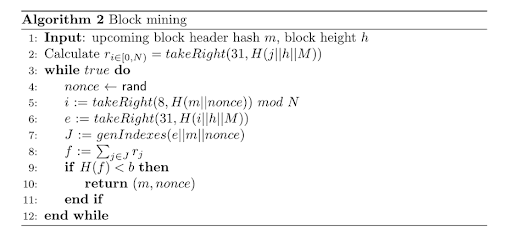
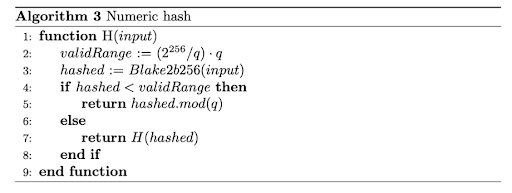
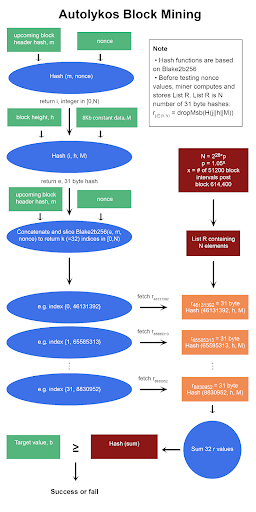
As a reminder, here are the block mining and hash function pseudocodes.

Autolykos Block Mining Pseudocode
unnamed (4).png

Blake2b256 Based Hash function
unnamed (5).png

Lines 3, 4 – begin while loop and guessing

After calculating list R, the miner creates a nonce guess and enters a loop to test if the nonce ultimately creates an output that is below the given target value.

Lines 5, 6 – seed for generating indexes

Line 5, i = takeRight(8, H(m||nonce)) mod N, produces an integer in [0,N). Algorithm 3 is utilized but with m and the nonce as inputs. Once the hash H(m||nonce) is returned, the 8 least significant bytes are kept and then passed through mod N. As a side note, the highest possible integer value with 8 bytes is 264 – 1, and assuming N = 226, an 8-byte hash mod N will result in the first few digits being zero. The number of zeros in i decreases as N grows.

Line 6 produces e, a seed for index generating. Algorithm 3 is called with inputs i (generated in line 5), h, and M. Then, the most significant byte of the numeric hash is dropped, and the remaining 31 bytes are kept as value e. It should also be noted that value e can be retrieved from list R instead of being computed since e is an r value.

Line 7 – index generator

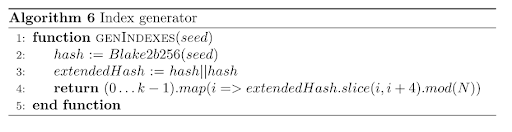
Element index J is created using Algorithm 6 with inputs e, m, and nonce. Function genIndexes is a pseudorandom one way that returns a list of k (=32) numbers in [0,N).

genIndexes function
unnamed (6).png

There are a couple of extra steps that are not shown in the pseudocode such as a byteswap. The creation and application of genIndexes can be explained via the following example:

GenIndexes(e||m||nonce)...

hash = Blake2b256(e||m||nonce) = [0xF963BAA1C0E8BF86, 0x317C0AFBA91C1F23, 0x56EC115FD3E46D89, 0x9817644ECA58EBFB]

hash64to32 = [0xC0E8BF86, 0xF963BAA1, 0xA91C1F23, 0x317C0AFB, 0xD3E46D89 0x56EC115F, 0xCA58EBFB, 0x9817644E]

extendedhash (i.e., byteswap and concatenate 4 bytes by repeating first 4 bytes) = [0x86BFE8C0, 0xA1BA63F9, 0x231F1CA9, 0xFB0A7C31, 0x896DE4D3, 0x5F11EC56, 0xFBEB58CA, 0x4E641798, 0x86BFE8C0]

The following python code shows the process of slicing the extended hash, returning k indexes. In this example we are assuming h < 614,400, thus N = 226 (67,108,864).

Slicing and mod N[1]
for i in range(8):
idxs[i << 2] = r[i] % np.uint32(ItemCount)
idxs[(i << 2) + 1] = ((r[i] << np.uint32(8)) | (r[i + 1] >> np.uint32(24))) % np.uint32(ItemCount)
idxs[(i << 2) + 2] = ((r[i] << np.uint32(16)) | (r[i + 1] >> np.uint32(16))) % np.uint32(ItemCount)
idxs[(i << 2) + 3] = ((r[i] << np.uint32(24)) | (r[i + 1] >> np.uint32(8))) % np.uint32(ItemCount)

The main takeaway is that slicing returns k indexes which are pseudorandom values derived from the seed, i.e., e, m, and nonce.

return [0x2BFE8C0, 0x3E8C0A1, 0xC0A1BA, 0xA1BA63, 0x1BA63F9, 0x263F923, 0x3F9231F, 0x1231F1C, 0x31F1CA9, 0x31CA9FB, 0xA9FB0A, 0x1FB0A7C, 0x30A7C31, 0x27C3189, 0x31896D, 0x1896DE4, 0x16DE4D3, 0x1E4D35F, 0xD35F11, 0x35F11EC, 0x311EC56, 0x1EC56FB, 0x56FBEB, 0x2FBEB58, 0x3EB58CA, 0x358CA4E, 0xCA4E64, 0x24E6417, 0x2641798, 0x179886, 0x39886BF, 0x86BFE8]

This index can be translated to values in base 10 as it refers to numbers in [0, N). For instance, 0x2BFE8C0 = 46131392, 0x3E8C0A1 = 65585313, 0xC0A1BA = 12624314, and so on. The miner uses these indexes to retrieve k r values.

The genIndexes function prevents optimizations as it is extremely difficult, basically impossible, to find a seed such that genIndexes(seed) returns desired indexes.

Line 8 – sum of r elements given k

Using the index generated in line 7, the miner retrieves the corresponding k (=32) r values from list R and sums these values. This might sound confusing but let’s break it down.

Continuing the example above, the miner stores the following indexes:

{0 | 46,131,392},
{1 | 65,585,313},
{2 | 12,624,314},
{3 | 10,599,011},

{31 | 8,830,952}

Given the indexes above, the miner retrieves the following r values from list R stored in memory.

{0 | 46,131,392} → dropMsb(H(46,131,392||h||M))
{1 | 65,585,313} → dropMsb(H(65,585,313||h||M))
{2 | 12,624,314} → dropMsb(H(12,624,314||h||M))
{3 | 10,599,011} → dropMsb(H(10,599,011||h||M))

{31 | 8,830,952} → dropMsb(H(8,830,952||h||M))

Note that Takeright(31) operated on a 32-byte hash can also be written as dropMsb – drop most significant byte.

Since the miner already stores list R in RAM, the miner does not need to compute k (= 32) Blake2b256 functions and instead looks up the values. This is a key feature of ASIC resistance. An ASIC with limited memory needs to compute 32 Blake2b256 iterations to get the values that could have been looked up in memory, and fetching from memory takes much less time. Not to mention, an ASIC with limited memory would require 32 Blake2b256 instances physically on die to achieve one hash per cycle, which would require more area and higher costs. It's simple to prove that storing list R in memory is well worth the trade off. Assume the following, a GPU has a hash rate of G = 100MH/s, _N = 226, k = 32, block interval t = 120 seconds, and elements are looked up every 4 hashes. I like to assume that elements are looked up every 4 hashes because, for each nonce guess, multiple elements such as i, J, and H(f) require Algorithm 3, i.e. blake2b hash, instances. We can estimate that each r value will be used, on average, (G * k * t)/(N*4) = 1430.51 times.

Once the 32 r values are looked up, they are summed.

Line 9, 10, 11, 12 – check if hash of sum is below target

The sum of the 32 r values is hashed using Algorithm 3, and if the output is below target b, the PoW is successful, m and nonce are returned to network nodes, and the miner is rewarded in ERG. If the sum hash is above the target, Lines 4 – 11 are repeated with a new nonce.

If you have made it this far, congratulations! After reading all of this information, you should have a good understanding of Autolykos v2! If you would like to see a visual demonstration of Autolykos, please see the graphic at the end of this document. If you would like a video explanation, you can find it here.

ASIC Resistance

We know from Ethereum that ‘memory hard’ algorithms can be conquered by integrating memory on ASICs. Ergo is different but let’s first revise why an ASIC with limited memory is uncompetitive and why a miner needs to store list R. Line 8 of Autolykos block mining deters machines with limited memory. If an ASIC miner does not store list R, they require a lot of cores to generate the 31-byte numeric hashes on the fly. 32 r values cannot be efficiently calculated using a single core loop because an output would only be generated every 32nd hash cycle. Given J, to compute one nonce per hash cycle, at least 32 Blake2b256 instances running dropMsb(H(j||h||M)) are needed. As we mentioned above, this increases die size and cost significantly. It’s clear that storing list R is worthwhile because having 32, or even 16, cores is very expensive. More to the point, reading memory is faster than computing Blake instances every time a nonce is tested.

Let’s see if an ASIC with sufficient memory is competitive because that is more relevant to the discussion. Comparing Ethash and Autolykos, the difference is that Ethash involves N elements when hashing the nonce and header mixes 64 times, whereas Autolykos involves N elements when fetching 32 r values based on indexes generated. For every tested nonce, Autolykos runs about 4 Blake2b256 instances and 32 memory fetches while Ethash runs about 65 SHA-3 like instances and 64 memory fetches. Not to mention, k is currently set at 32 but this value can be increased to retrieve more r values if needed. ASICs that run Ethash have a lot of room to increase SHA3 hashing speed since 65 hashes are completed per tested nonce compared to about 4 on Autolykos. The ratio of memory fetches to hash instances is much greater on Autolykos. For this reason, Autolykos is more memory hard than Ethash since memory bandwidth plays a much larger role compared to hashing speed.

An area where Autolykos optimization could take place is the filling of list R. The filling of list R requires N instances of a Blake2b256 function. N is large and only getting larger, so that’s a lot of hashing. An ASIC could optimize the speed of Blake2b256, yielding more time for block mining since list R is filled sooner. Although this can be done, filling list R requires cycling through [0, N) and a GPU with 32-wide multiprocessors can already fill list R very fast (in seconds). One would need an ASIC with many Blake cores to be significantly faster – again, very expensive, and probably not worthwhile since the bottleneck could become memory write bandwidth (i.e., writing list R to RAM rather than hashing speed).

The last area that can be optimized for Autolykos is memory read/write speed. Ethash ASIC miners have a slightly faster read speed compared to GPUs as the memory is clocked higher without the effect of GPU throttling. However, this difference is pretty insignificant and is expected to become more insignificant as GPUs advance. This is because the memory hardware itself is the same: DRAM. One may question if a faster memory hardware could be utilized whereby memory read and write speed is far quicker… SRAM, for instance, could be an imaginable next step in breaking memory hard algorithms, however, SRAM is not a feasible solution simply because it is less dense.

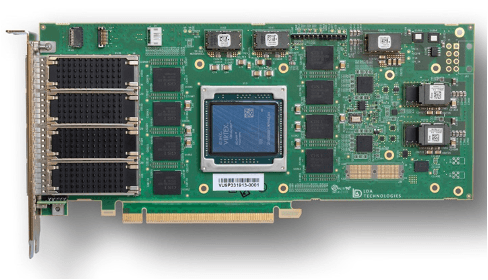
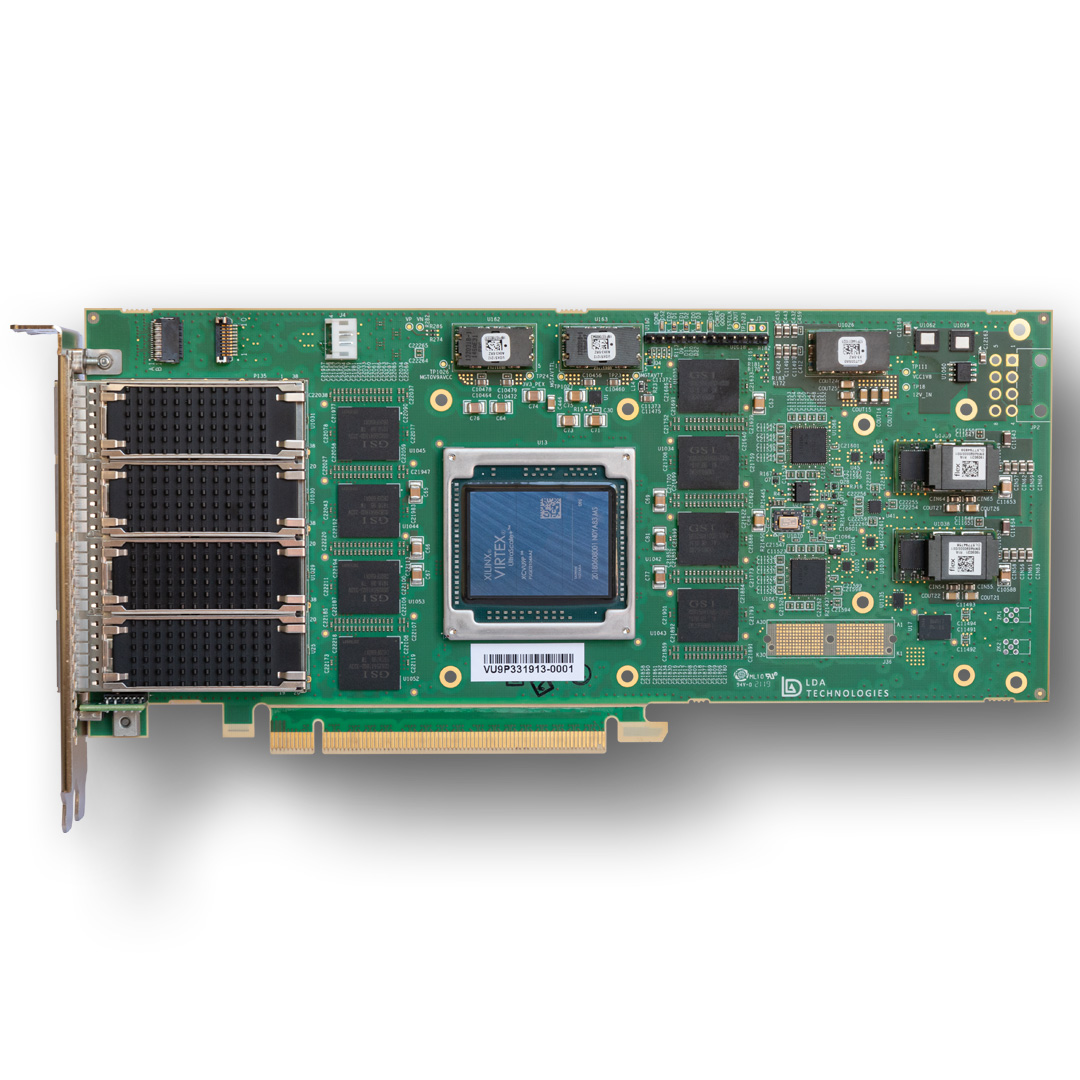
SRAM on FPGA[2]

unnamed (7).png

The above photo is an FPGA with 8 memory chips on the front, and there are another 8 on the back. The total SRAM memory is only 576MB. Fitting sufficient SRAM on a die won’t work because the SRAM will need to be placed further from the core as it is note dense enough to fit in one layer around the core. This can result in read/write delays because electricity needs to travel longer distances even though the hardware itself is faster. Additionally, to mine Ergo, the memory requirement increases as N increases so fitting sufficient SRAM is not feasible overtime. Thus, SRAM ASICs are not worthwhile exploring even if one had enough cash to spend on SRAM itself.

Blake2b256

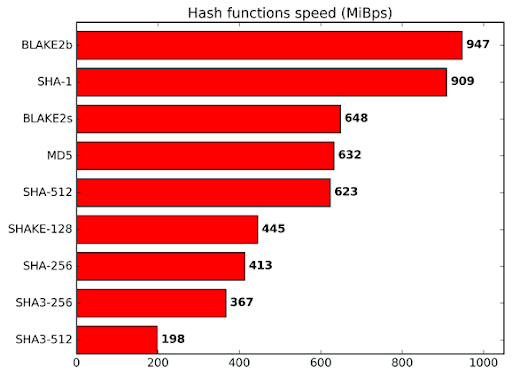
One major difference between an algorithm like Autolykos and others is the use of Blake2b256. This is no coincidence. Blake relies heavily on addition operations for hash mixing instead of XOR operations. An operation like XOR can be done bit by bit whereas addition requires carry bits. Thus, Blake requires more power and core area compared to SHA algorithms, but it is still as secure and in fact, faster. As mentioned on the Blake2 website, “BLAKE2 is fast in software because it exploits features of modern CPUs, namely instruction-level parallelism, SIMD instruction set extensions, and multiple cores.”[3] Thus, while an ASIC can output Blake instances faster, the innate nature of the function limits optimizations by requiring addition and involving features found in CPUs as well as GPUs.

Blake2b speed relative to other hash functions

unnamed (8).png

Conclusion

Autolykos is a great innovation that is a necessary response to combat the rise of PoW-optimized ASIC machines. We hope this 2-part series has helped you to understand Autolykos at a more technical level and why it is more memory hard than Ethash. As Ethereum transitions to a PoS network, there will be a large community of miners looking for a place to direct their hashrate power, and Ergo should be a significant player in attracting those miners.

If you enjoyed this article, the author invites you to check out more content via their Twitter account, @TheMiningApple.

unnamed (9).png

[1] Credit to Wolf9466#9466 on Discord
[2] http://www.ldatech.com/_images/imageGallery/SBM09P-3_front.jpg
[3] https://www.blake2.net/#:~:text=A%3A%20BLAKE2%20is%20fast%20in,of%20the%20designers%20of%20BLAKE2).

Share post

Ergo基础设施DAO:去中心化Ergo生态系统的支柱

Ergo基础设施DAO:去中心化Ergo生态系统的支柱

Ergo的使命一直根植于去中心化,不仅在共识层面,而是在整个技术栈中。随着Ergo基础设施DAO (InfraDAO)的推出,这一愿景正在扩展到每天为生态系统提供动力的服务和基础设施。 InfraDAO现在在Paideia上正式上线,经过成功的治理投票。最初.

Ergo Platform

2025年8月13日

Mew Finance:一个为Ergo生态系统提供的有趣DeFi工具包

Mew Finance:一个为Ergo生态系统提供的有趣DeFi工具包

Mew Finance是一个基于Ergo区块链的去中心化应用套件。该项目于2024年10月启动,将DeFi、数字资产和跨链功能整合到一个统一的平台中。长期社区开发者HQΣr和Aco Šmrkas领导该项目。设计上偏向模块化、易用性和深度生态系统集成。 本文是.

Ergo Platform

2025年8月12日

Lithos:通过链上矿池实现去中心化挖矿

Lithos:通过链上矿池实现去中心化挖矿

Lithos是一个新协议,旨在通过将矿池转移到链上来彻底改革矿池的运作方式,使矿工完全控制,并消除对中心化矿池运营商的需求。与之前大多数去中心化挖矿的尝试不同,Lithos旨在高效、可扩展和安全。 什么是Lithos? Lithos是一个去中心化的矿池协议.

Ergo Platform

2025年7月24日

Sigma 6.0:更智能、更灵活的Ergo

Sigma 6.0:更智能、更灵活的Ergo

Sigma 6.

Ergo Platform

2025年7月23日

塑造Rosen的未来:关于五项关键财政提案的社区呼吁

塑造Rosen的未来:关于五项关键财政提案的社区呼吁

Rosen的联合创始人Armeanio已向Rosen财政提交了五项新提案。这些提案概述了Rosen Bridge的增长、实用性和可扩展性的战略愿景,这是Ergo互操作性基础设施的核心组成部分。 这是Ergo社区审查和讨论这一重要跨链服务未来方向的关键时刻。以.

Ergo Platform

2025年7月9日

Ergo的扩展UTXO与人工经济智能的崛起

Ergo的扩展UTXO与人工经济智能的崛起

自主经济代理的实用愿景 Ergo区块链上的自主经济代理在真实的数字经济中执行有用的工作。它们通过创建内容和提供数据分析、模式识别等服务来产生收入。它们利用收入支付运营费用,如托管费和服务器成本,并使用现代工具,如SSH和加密友好的托管服务提供商。当有额外资金.

Ergo Platform

2025年5月12日

ErgoHACK X:在Ergo区块链上的人工智能

ErgoHACK X:在Ergo区块链上的人工智能

庆祝去中心化创新的十年 加入第十届ErgoHACK,站在Ergo区块链AI革命的最前沿!释放你的创造力,与其他创新者合作,共同构建去中心化AI的未来。 关于ErgoHack ErgoHACK,旗舰社区黑客马拉松,庆祝其十周年!这一里程碑事件是Ergo生态系统.

Ergo Platform

2025年4月10日

ERG正式上线Kucoin(库币)交易所

ERG正式上线Kucoin(库币)交易所

据Kucoin官方通告,Ergo平台原生代币ERG于8月3日正式上线Kucoin(库币)交易所。目前支持的交易对是ERG/USDT。现已开放充值;2021年8月5日UTC时间上午10:00开放交易;2021年8月6日UTC时间上午10:00开放提币。 .

Ergo Foundation

2021年8月3日

Ergo两周年纪念——早期采用者应了解的核心知识

Ergo两周年纪念——早期采用者应了解的核心知识

Normal 0 false false false EN-US ZH-CN X-NONE /* Style Definitions */ table.

root7Z

2021年7月5日

关于Ergo启用官方QQ频道的公告

关于Ergo启用官方QQ频道的公告

由于Ergo官方微信号暂无法使用,Ergo官方现新增Ergo官方QQ频道:796039547。全球中文用户可通过扫描下面的二维码加入Ergo中文社区,及时了解Ergo最新官方动态. .

Eva Qing

2021年6月30日

Ergo首届黑客松大赛ERGOHACK圆满结束

Ergo首届黑客松大赛ERGOHACK圆满结束

Ergo首届黑客松大赛已经圆满结束,它正如计划那样:规模小而富有实验性,但依然收到了一些很棒的作品提交。Kushti以他的开场视频拉开了活动的序幕,然后我们总共有六个团队,其中来自anon_real(AuctionHouse、SigmaUSD UI等项目的创建.

Curia Regis Crypto

2021年6月29日

关于举办首届Ergo中国社区驱动践行活动的公告

关于举办首届Ergo中国社区驱动践行活动的公告

为了进一步提高Ergo公链平台在中国的知名度,让更多用户深入了解Ergo,同时为了践行Ergo社区驱动的理念,Ergo中国社区现特别举办“首届Ergo中国社区驱动践行活动”。活动参与者积极向新用户布道Ergo并将其引至Ergo官方指定社群,将有机会赢取ERG奖.

Eva Qing

2021年6月4日

比特币的前进之路是努力追赶Ergo ——Ergo率先实现扩展UTXO智能合约

比特币的前进之路是努力追赶Ergo ——Ergo率先实现扩展UTXO智能合约

比特币 比特币是一头野兽。是的,其底层软件需要认真升级。它真的太慢了。但是,您也必须承认它的优势,网络效应是非常强大的------比特币是加密货币之王。在全球范围内,比特币正成为一个常见、被理解和被采用的术语。大型信托、投资巨头和对冲基金经理,都被比特币的主.

Curia Regis Crypto

2021年5月23日

关于Ergo基金会任命谭声情先生担任中国区大使的公告

关于Ergo基金会任命谭声情先生担任中国区大使的公告

经Ergo基金会批准,现任命谭声情先生(英文名:Tango)担任Ergo中国区大使。 为了提升Ergo在中国的知名度与影响力,Ergo基金会现授权谭声情先生以Ergo中国区大使身份进行Ergo在中国的品牌宣传、商务洽谈、社区活动、主题推广等事宜。 此任命自.

Ergo Team

2021年5月16日

硬分叉事后说明

硬分叉事后说明

英文链接: 应@kushti的请求,我现在给大家说明一下今天在硬分叉升级期间发生的事情。有一些BUG导致矿工无法出块,现已修补好这些BUG,矿工可以出块。 version2ActivationDifficultyHex中出现往返编码失败(Round-T.

Eva Qing

2021年2月3日

硬分叉升级后Ergo挖矿须知

硬分叉升级后Ergo挖矿须知

Ergo将在区块#417,792上进行硬分叉协议升级。此次升级会引入重大更改,包括将关闭不可外包功能(Non-Outsourceability)。经过此次硬分叉之后,新的PoW(被称为Autolykos v2.

Eva Qing

2021年2月1日

如何设置和配置Ergo全节点

如何设置和配置Ergo全节点

如何设置和配置Ergo全节点 本教程说明了如何安装和运行Ergo全节点,不涵盖挖矿。  Windows用户还可以观看视频教程。 如何在Windows上设置和配置Ergo全节点 视频链接: 节点安全 这里是节点使用的一些重要方面,您的钱包及代币是否安全.

Eva Qing

2021年1月21日

既想享受乐趣,又想赚取利润? ——那就赶紧来挖ERG

既想享受乐趣,又想赚取利润? ——那就赶紧来挖ERG

Ergo GPU挖矿 本文将帮助您开始使用GPU挖矿Ergo原生代币ERG。 Ergo挖矿基于Autolykos,即一种工作量证明(PoW)算法,被设计为阻碍ASIC矿机和矿池。矿工须执行存储困难的计算(需要至少4 GB的内存,但是当前最有效的实现使用的是.

Eva Qing

2021年1月21日

适用于AMD GPU的Autolykos v2(Ergo)的OpenCL挖矿软件

适用于AMD GPU的Autolykos v2(Ergo)的OpenCL挖矿软件

适用于ergoplatform.

Eva Qing

2021年1月19日

适用于Nvidia GPU的Autolykos v2(Ergo)用Cuda挖矿软件

适用于Nvidia GPU的Autolykos v2(Ergo)用Cuda挖矿软件

用于ergoplatform.

Eva Qing

2021年1月19日

尔格基金会为主要去中心化应用(dApp)基础设施提供资助

尔格基金会为主要去中心化应用(dApp)基础设施提供资助

尔格基金会将考虑支持重大生态系统开发项目提供资助的建议。 尔格是一个面向社区的项目,该生态系统的方方面面都有许多贡献者。尔格基金会会拿出一部分资金资助此项工作,这对于构建用户所需的日常产品与服务以及更多样化的金融去中心化应用至关重要。该基金会正在积极寻求.

Guy Brandon

2020年11月17日