Ergo & Blockchain: Tokenomics and Finance

Translation temporarily unavailable. Showing original English.
root7Z

2021年11月5日

The following article will look into core aspects of cryptocurrencies, decentralized finance (DeFi), tokenomics and the path of the Ergo Protocol. For the first episode in the Ergo & Blockchain series, please see Ergo & Blockchain: Cryptocurrency Sphere.

Crypto, Blockchain and  Finance

Cryptocurrencies rely on distributed ledger technology to maintain relevant data on the blockchain. A decentralized database consists of the nodes that carry the information, such as the number of wallets, tokens, nodes and the function of specific contracts stored on the blockchain. As Decentralized Finance (DeFi) becomes more accepted, it is important to prepare for a new functioning economic design.

When Satoshi Nakamoto created something new (Bitcoin) in opposition to traditional financial institutions, it was thought to be a hobby project by an anonymous developer. Quite often, it was thought to be a joke or a scam initiated to take away people’s money. Fast-forward to today and now Bitcoin is recognized as legal tender and gaining acceptance among financial firms. What once was thought to be “money out of thin air” has turned into something far beyond that touches more and more of everyday life.

The relevance of this is that the currency, in the form of data, is backed by computing power which is the outcome of running mining equipment and electricity. Users pay commission fees to miners for transaction verification and miners get extra rewards from the protocol for providing security. This is called the Proof of Work (PoW) consensus model on which Bitcoin, Ethereum, and Monero are built. Another model is called Proof of Stake (PoS). In PoS, the consensus is decided by the amount of staked tokens rather than the hash power from miners. There are different actors (Miner/Staker) and attack vectors (51/66/33% attacks) that these two core consensus models represent.

PoW and PoS Launch Models 

As the pioneer of PoW systems, Bitcoin did not have an initial coin offering (ICO) but instead had a fair launch where anyone could mine it with their computer hardware. Ethereum, on the other hand, pre-mined certain allocations (of coins) for the team and ecosystem funding and conducted an ICO before the mining started. Both launch models have different characteristics in terms of their allocators. In PoS, the foundation holds the vast majority of the funds at the launch phase and investors can obtain coins on ICO or buy them on secondary markets. There can also be pre-sale rounds that are open mainly for Venture Capitals (VC). In PoW, the only way to get the coins is by mining or buying on the secondary market from a seller. 

Ergo chose the PoW model with a fair launch and designed a treasury allocation for the ecosystem development as a portion of block rewards. Instead of offering a portion of pre-mined allocation, the Ergo Protocol allocated 7.5 ERG per 75 ERG block rewards as Treasury allocation for the first two years. Treasury allocation then drops to zero in the following six months. This plan yielded the treasury 4.33 million ERGs which represents 4.43% of the 97 million ERG total supply. This allocation was instituted in order to support the initial ecosystem development by releasing funds gradually during project development. Ergo launched in July 2019, so the emission rate has already started to decrease since last July.

In the PoS model launch, there is often a certain amount of foundation/team allocation and generally there is also the VC allocation in pre-sale. These allocations can either be vested linearly or unlocked at launch and investors can get coins at an ICO or secondary markets. Because these proportions can take up to huge numbers or sometimes more than 50%, it means that the core team has the liquidity and therefore the market-making power in the initial phases. Given that ICO prices are usually a couple of times higher than pre-sale rounds, retail investors will have a disadvantageous position compared to VCs. 

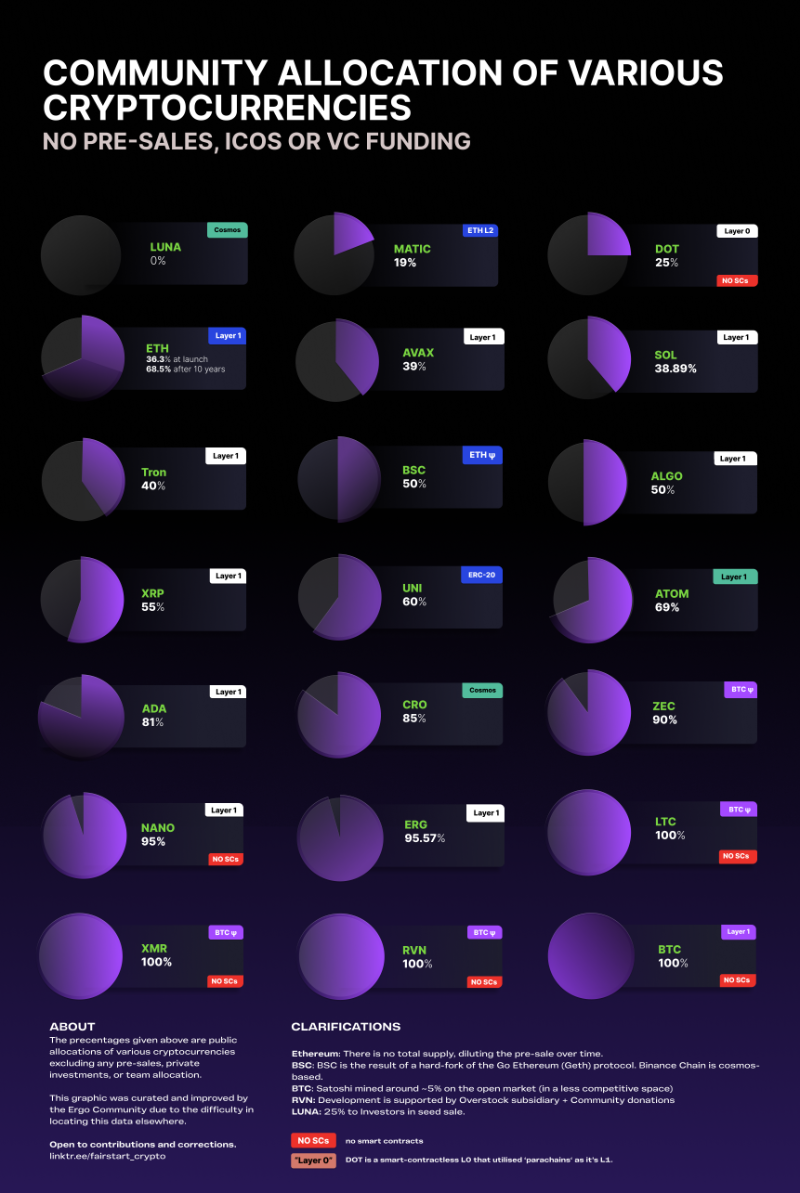
Below is an infographic displaying a comparison of token allocations for various projects
Fairest-of-them-all_smol.png

Tokenomics

Tokenomics, or Token Economics, is the key factor that separates cryptocurrency from fiat currency. Traditional monetary policies are defined by institutions and they are always subject to changes by the same institutions. Tokenomics on the other hand are written on blockchain and can not be changed without achieving a consensus to do so.

Fiat currencies are issued by central banks and their circulation is controlled by these centralized entities. As you may guess, this was necessary to prevent fraud and provide authentication in financial transactions. With distributed ledger technology, authentication is carried out by decentralized nodes and transactions are verifiable on the public ledger. Bitcoin did not need a 3rd party to prove the transactions on the blockchain or a central entity to govern its monetary policy.

So with the inception of Bitcoin, a new monetary system was created with 21 million hard-capped coins and a deflationary emission that lasts for 140 years at a predictable rate. Bitcoin’s emission halves every four years, reducing the block rewards that miners collect. Initially, there were 50 BTC rewards per block but now it has been reduced to 6.25 after the 2020 halving. 18.6 million Bitcoins have already been mined. This means 88% of the total supply is already in circulation after 13 years. 

Some cryptocurrencies such as Ethereum or Monero do not have hard-capped supplies, but instead a diminishing and predictable emission rate is set. According to the data at the time of this writing, emission rates for Ethereum and Monero are 0.54% and 0.96%, respectively. We can calculate the issuance rate for the next 10 or 50 years to predict the future inflation according to this emission rate. You can access various projects’ inflation rates at Messari under the metrics page/supply column.

In PoS projects where VCs have a head start, inevitably, the bigger stake gets bigger. VCs can accumulate big sums of coins in the pre-sale phase for cheap prices and they may start dumping with the ICO launch. If they stick to their investment and do not dump, they could be in control of blockchain governance in the future. Because consensus relies on the staked amount, most of the circulation will be illiquid and controlled by big money.

Ergo has a hard-capped supply of 97 million ERGs, which will be emitted over 8 years. The emission schedule may seem aggressive, however it should be noted that 80% of Bitcoin’s total supply has already emitted during its first 8 years and 88% is in circulation as of today. The circulating ERG supply is at 45 million, representing 46% of the total supply. The rest of the supply emission will be released over the next six years before PoW consensus rewards drop to zero. From there on, Storage Rent and the transaction fees paid by users will provide economic incentives for miners to run their equipment. 

Ergo’s protocol offers another economic incentive for miners, called Storage Rent. The Storage Rent component is a proposition to eradicate unused data bytes (dust) from the blockchain. Every four years, users will need to pay 0.13 ERGs per unused UTXO box . Unused or lost coins will be mineable and eventually flow back into circulation. This is a commitment to secure future cash flow and create a more liquid crypto economy. Users can simply move their coins every four years to avoid paying unnecessary storage rent.

Social Transformation

Blockchain technology and smart contract development are moving at an increasingly fast rate. We see that new laws are passing globally, financial institutions have started allocating crypto portfolios, and just recently, the SEC approved the first Bitcoin exchange trading fund on the NASDAQ. Yet there is strong opposition to the institutionalization of Bitcoin and cryptocurrencies. Who will be controlling your funds in the future? Can cryptocurrencies really become a tool for ordinary people against centralized entities? 

While Central Bank Digital Currencies (CBDC) are on the horizon, a vital choice is fast approaching. How will regulations evolve in regard to ownership rights and privacy? Will blockchains and cryptocurrencies become the ultimate tool for social surveillance? 

Keep an eye out for the next chapter in this series of articles: Ergo & Blockchain: Privacy and Security.

Share post

Ergo基础设施DAO:去中心化Ergo生态系统的支柱

Ergo基础设施DAO:去中心化Ergo生态系统的支柱

Ergo的使命一直根植于去中心化,不仅在共识层面,而是在整个技术栈中。随着Ergo基础设施DAO (InfraDAO)的推出,这一愿景正在扩展到每天为生态系统提供动力的服务和基础设施。 InfraDAO现在在Paideia上正式上线,经过成功的治理投票。最初.

Ergo Platform

2025年8月13日

Mew Finance:一个为Ergo生态系统提供的有趣DeFi工具包

Mew Finance:一个为Ergo生态系统提供的有趣DeFi工具包

Mew Finance是一个基于Ergo区块链的去中心化应用套件。该项目于2024年10月启动,将DeFi、数字资产和跨链功能整合到一个统一的平台中。长期社区开发者HQΣr和Aco Šmrkas领导该项目。设计上偏向模块化、易用性和深度生态系统集成。 本文是.

Ergo Platform

2025年8月12日

Lithos:通过链上矿池实现去中心化挖矿

Lithos:通过链上矿池实现去中心化挖矿

Lithos是一个新协议,旨在通过将矿池转移到链上来彻底改革矿池的运作方式,使矿工完全控制,并消除对中心化矿池运营商的需求。与之前大多数去中心化挖矿的尝试不同,Lithos旨在高效、可扩展和安全。 什么是Lithos? Lithos是一个去中心化的矿池协议.

Ergo Platform

2025年7月24日

Sigma 6.0:更智能、更灵活的Ergo

Sigma 6.0:更智能、更灵活的Ergo

Sigma 6.

Ergo Platform

2025年7月23日

塑造Rosen的未来:关于五项关键财政提案的社区呼吁

塑造Rosen的未来:关于五项关键财政提案的社区呼吁

Rosen的联合创始人Armeanio已向Rosen财政提交了五项新提案。这些提案概述了Rosen Bridge的增长、实用性和可扩展性的战略愿景,这是Ergo互操作性基础设施的核心组成部分。 这是Ergo社区审查和讨论这一重要跨链服务未来方向的关键时刻。以.

Ergo Platform

2025年7月9日

Ergo的扩展UTXO与人工经济智能的崛起

Ergo的扩展UTXO与人工经济智能的崛起

自主经济代理的实用愿景 Ergo区块链上的自主经济代理在真实的数字经济中执行有用的工作。它们通过创建内容和提供数据分析、模式识别等服务来产生收入。它们利用收入支付运营费用,如托管费和服务器成本,并使用现代工具,如SSH和加密友好的托管服务提供商。当有额外资金.

Ergo Platform

2025年5月12日

ErgoHACK X:在Ergo区块链上的人工智能

ErgoHACK X:在Ergo区块链上的人工智能

庆祝去中心化创新的十年 加入第十届ErgoHACK,站在Ergo区块链AI革命的最前沿!释放你的创造力,与其他创新者合作,共同构建去中心化AI的未来。 关于ErgoHack ErgoHACK,旗舰社区黑客马拉松,庆祝其十周年!这一里程碑事件是Ergo生态系统.

Ergo Platform

2025年4月10日

ERG正式上线Kucoin(库币)交易所

ERG正式上线Kucoin(库币)交易所

据Kucoin官方通告,Ergo平台原生代币ERG于8月3日正式上线Kucoin(库币)交易所。目前支持的交易对是ERG/USDT。现已开放充值;2021年8月5日UTC时间上午10:00开放交易;2021年8月6日UTC时间上午10:00开放提币。 .

Ergo Foundation

2021年8月3日

Ergo两周年纪念——早期采用者应了解的核心知识

Ergo两周年纪念——早期采用者应了解的核心知识

Normal 0 false false false EN-US ZH-CN X-NONE /* Style Definitions */ table.

root7Z

2021年7月5日

关于Ergo启用官方QQ频道的公告

关于Ergo启用官方QQ频道的公告

由于Ergo官方微信号暂无法使用,Ergo官方现新增Ergo官方QQ频道:796039547。全球中文用户可通过扫描下面的二维码加入Ergo中文社区,及时了解Ergo最新官方动态. .

Eva Qing

2021年6月30日

Ergo首届黑客松大赛ERGOHACK圆满结束

Ergo首届黑客松大赛ERGOHACK圆满结束

Ergo首届黑客松大赛已经圆满结束,它正如计划那样:规模小而富有实验性,但依然收到了一些很棒的作品提交。Kushti以他的开场视频拉开了活动的序幕,然后我们总共有六个团队,其中来自anon_real(AuctionHouse、SigmaUSD UI等项目的创建.

Curia Regis Crypto

2021年6月29日

关于举办首届Ergo中国社区驱动践行活动的公告

关于举办首届Ergo中国社区驱动践行活动的公告

为了进一步提高Ergo公链平台在中国的知名度,让更多用户深入了解Ergo,同时为了践行Ergo社区驱动的理念,Ergo中国社区现特别举办“首届Ergo中国社区驱动践行活动”。活动参与者积极向新用户布道Ergo并将其引至Ergo官方指定社群,将有机会赢取ERG奖.

Eva Qing

2021年6月4日

比特币的前进之路是努力追赶Ergo ——Ergo率先实现扩展UTXO智能合约

比特币的前进之路是努力追赶Ergo ——Ergo率先实现扩展UTXO智能合约

比特币 比特币是一头野兽。是的,其底层软件需要认真升级。它真的太慢了。但是,您也必须承认它的优势,网络效应是非常强大的------比特币是加密货币之王。在全球范围内,比特币正成为一个常见、被理解和被采用的术语。大型信托、投资巨头和对冲基金经理,都被比特币的主.

Curia Regis Crypto

2021年5月23日

关于Ergo基金会任命谭声情先生担任中国区大使的公告

关于Ergo基金会任命谭声情先生担任中国区大使的公告

经Ergo基金会批准,现任命谭声情先生(英文名:Tango)担任Ergo中国区大使。 为了提升Ergo在中国的知名度与影响力,Ergo基金会现授权谭声情先生以Ergo中国区大使身份进行Ergo在中国的品牌宣传、商务洽谈、社区活动、主题推广等事宜。 此任命自.

Ergo Team

2021年5月16日

硬分叉事后说明

硬分叉事后说明

英文链接: 应@kushti的请求,我现在给大家说明一下今天在硬分叉升级期间发生的事情。有一些BUG导致矿工无法出块,现已修补好这些BUG,矿工可以出块。 version2ActivationDifficultyHex中出现往返编码失败(Round-T.

Eva Qing

2021年2月3日

硬分叉升级后Ergo挖矿须知

硬分叉升级后Ergo挖矿须知

Ergo将在区块#417,792上进行硬分叉协议升级。此次升级会引入重大更改,包括将关闭不可外包功能(Non-Outsourceability)。经过此次硬分叉之后,新的PoW(被称为Autolykos v2.

Eva Qing

2021年2月1日

如何设置和配置Ergo全节点

如何设置和配置Ergo全节点

如何设置和配置Ergo全节点 本教程说明了如何安装和运行Ergo全节点,不涵盖挖矿。  Windows用户还可以观看视频教程。 如何在Windows上设置和配置Ergo全节点 视频链接: 节点安全 这里是节点使用的一些重要方面,您的钱包及代币是否安全.

Eva Qing

2021年1月21日

既想享受乐趣,又想赚取利润? ——那就赶紧来挖ERG

既想享受乐趣,又想赚取利润? ——那就赶紧来挖ERG

Ergo GPU挖矿 本文将帮助您开始使用GPU挖矿Ergo原生代币ERG。 Ergo挖矿基于Autolykos,即一种工作量证明(PoW)算法,被设计为阻碍ASIC矿机和矿池。矿工须执行存储困难的计算(需要至少4 GB的内存,但是当前最有效的实现使用的是.

Eva Qing

2021年1月21日

适用于AMD GPU的Autolykos v2(Ergo)的OpenCL挖矿软件

适用于AMD GPU的Autolykos v2(Ergo)的OpenCL挖矿软件

适用于ergoplatform.

Eva Qing

2021年1月19日

适用于Nvidia GPU的Autolykos v2(Ergo)用Cuda挖矿软件

适用于Nvidia GPU的Autolykos v2(Ergo)用Cuda挖矿软件

用于ergoplatform.

Eva Qing

2021年1月19日

尔格基金会为主要去中心化应用(dApp)基础设施提供资助

尔格基金会为主要去中心化应用(dApp)基础设施提供资助

尔格基金会将考虑支持重大生态系统开发项目提供资助的建议。 尔格是一个面向社区的项目,该生态系统的方方面面都有许多贡献者。尔格基金会会拿出一部分资金资助此项工作,这对于构建用户所需的日常产品与服务以及更多样化的金融去中心化应用至关重要。该基金会正在积极寻求.

Guy Brandon

2020年11月17日